Alignment

When you hear the word alignment, what comes to mind? The dictionary defines alignment as arrangement in a straight line, or in correct or appropriate relative positions or  a position of agreement or alliance. This can mean a multitude of things as it relates to decisions we make, how we conduct ourselves, and even how we literally move our bodies in space.

To be “out of alignment” can be simply understood as an arrangement in which two or more things are not positioned correctly in a straight line or parallel to each other. In Yoga we hear a lot about the body being in alignment, but can that statement also relate to how you show up in the world?

Living Alignment

Remember last month I asked you to determine what makes up the roots or foundation that sustains you when life gets hard? Now it is time to put the proof in the pudding and see if your words, thoughts, and actions are in alignment with that.

Let’s say that integrity is a value you hold as something that keeps you steady. Then your actions dictate otherwise; you mislead people, you are a doormat for others to mislead you, you often fudge or hide the truth, or possibly you make decisions that are anything but ones packed with integrity. Simply thinking, if you say being healthy is important to you and you consume crappy food and toxic media, it is probable you are out of alignment with what you say you find important.

Alignment in Yoga

If you have been paying attention for long you may notice that I am big believer in living yoga and not just practicing yoga. I believe that far more of the yoga principles are implemented off the mat (or chair) and teach this all the time. The shape our bodies create while practicing is just a small part of it.

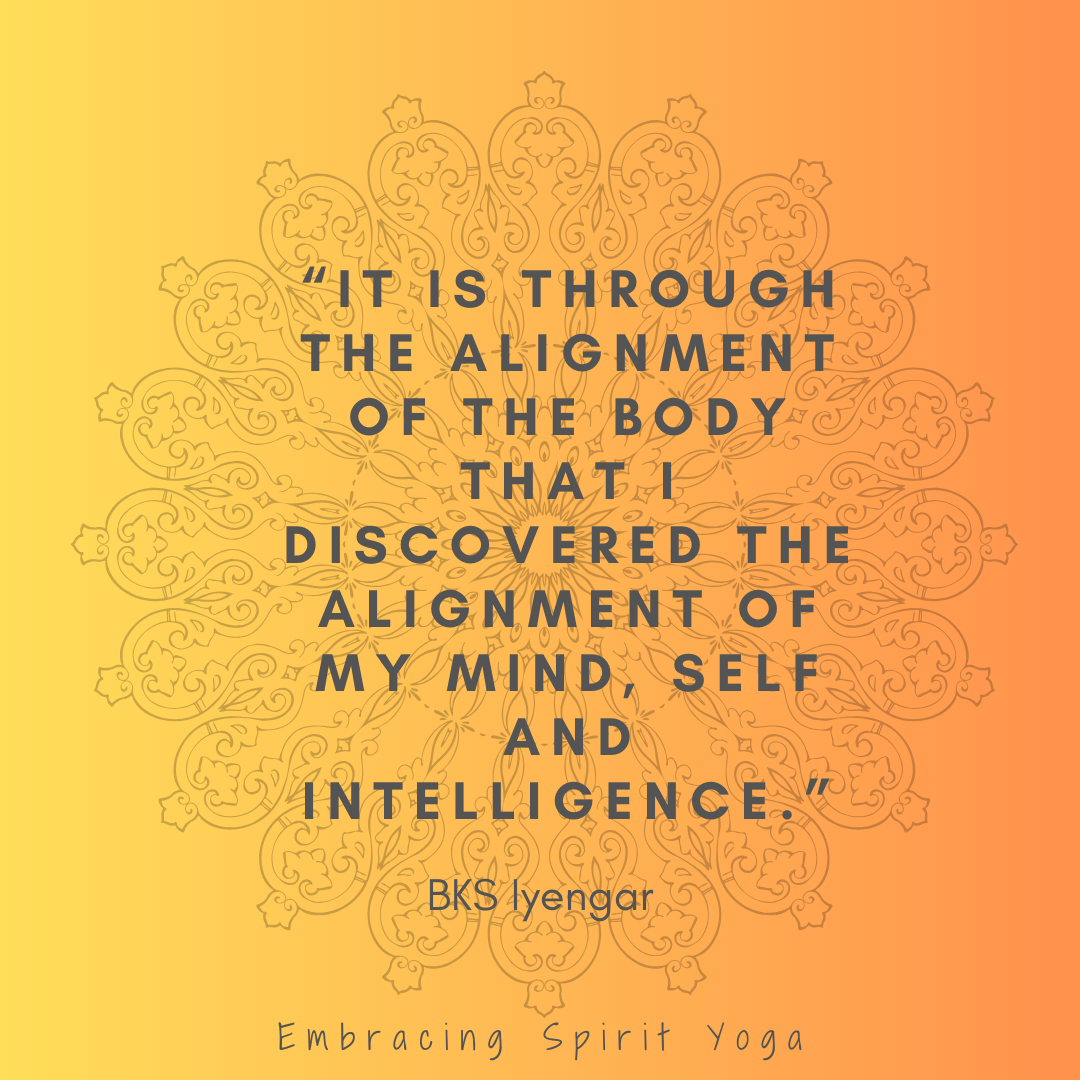
In Yoga, the principle of Alignment is closely related to principles like: balance, symmetry, precision and harmony – all are fundamental principles in yoga practice. Iyengar Yoga is the practice of precision. Poses are held for long periods and often modified with props. This method is designed to systematically cultivate strength, flexibility, stability, and awareness, and can be therapeutic for specific conditions. B.K.S. Iyengar, an Indian teacher and guru, founded Iyengar Yoga. Iyengar says:

Alignment is to bring balance between the flow of energy and intelligence to connect the body to the mind.” And then, he says “We adjust not the body, but the awareness. The moment the awareness is brought to function, then the body finds its right alignment and adjusts; as water finds its level, the awareness, too, finds its level.”

Having Awareness

Practicing yoga on the mat (or in chair) is a sure way to bring awareness to the language your body speaks. It invites you to pay close attention the nuances of the shape your body is in. It encourages you to listen and make adjustments along the way.

Imagine having this type of awareness in the thoughts you have? Or the words that you speak? How about the actions (or lack of) that you do everyday?

Putting the principles of alignment into your daily life following the “practice” will integrate the principles of this beautiful lifestyle into your life.

Join me on Youtube this month as I walk you through a weekly practice of alignment. There I will suggest ways to align yourself with what you said keeps you steady.

The Greatest Gift of Alignment

We have all had that magical feeling when everything in our life is flowing well. Our relationships are easy and fulfilling and we feel balanced. Or, when it seems that everything we attempt becomes a success. When life feels “easy” and we are rarely agitated by everyday things, it is likely we are in alignment. You might say it is as if you are in the beautiful flow of life where a gentle reciprocity exists in all areas.

This is the divine alignment. You are in it.

Autumn Equinox

The Autumn Equinox is a time of letting go and harvesting the good that is abundant in our lives. To allow the stalks and leaves to fall aside and go back to the Earth. With this beautiful and colorful season emerging it is our time to loosen our grip on the focus of growth and prepare to move into a more dormant season.

Autumn Equinox and cycles 

This is also a great time to look at the cycles of life; seasons, months, breath, and even life. As we embrace the time of gathering our harvest we are also preparing ourselves for the cycle in which we become more hunkered down. A little more in hibernation mode. The paradox of understanding cycles exists everywhere. 

The simplest observation is the breath; to inhale you must also exhale.

When we are awake we come to know that with each ending there is a beginning in whatever shape that takes; self awareness, growth, wisdom, letting go, forgiveness and grief.  If we pay attention, we can see this so easily in the changing of leaves. The amazing color that emerges following a season of bounty. Then the ease in which the leaf lets go. Watch as leaves effortlessly fall to the ground. They are taken into the loving arms of Mother Earth for the new growth that waits for the next season.

Take time to look at letting go of what no longer serves you.

At the autumn equinox there is a dynamic shift. The season of sunshine, growth, taking action, movement to a more quiet and still season. This time of year during the equinox is a powerful time to pause after the often chaotic energy of summer. Back to school and busy-ness to a more dormant and contemplative time.

This is time where we replenish, regenerate and recuperate from a season of push. 

Well, at least we should try to as the we are so in tune with nature and the natural rhythms of the world, if we are paying attention. Nature responds to the lessening hours of daylight by slowly fading into dormancy. Watch as the leaves fall from trees, the lush green of shrubs and vegetation fades, and animals forage and gather for a season of hibernation. How do we mimic these natural occurrences? We withdraw from the rush of outward action to a season of a more contemplative inner reflection of our spirit.

With this season also comes a wonderful reminder to gather your harvests and share with others and to celebrate the abundance of the world with your neighbors, your family, or even a stranger. We tend to want to hang on to “things”, both tangible and intangible and really all that does is is exhaust us and stop the flow of goodness.

During a yoga practice watch as you move in and out of balance and neutral. How your breath becomes rapid and slow, though we strive for equality of breath. Notice how the tension in our body is often paired with ease. Thoughts come and thoughts go.

The skills that we learn on the yoga to find neutral, equanimity, and harmony teach us the gift of following the rhythm of nature. Remember, our time on the mat is truly a practice for living yoga as we know that yoga really happens off the mat. 

Our practice this time of year should reflect the message of the equinox and allow it to be filled with times of pausing to gather your breath, to reflect in mountain pose with a sense of neutrality and to find the balance between dynamic postures and stillness.

Welcome the harvest that is within and always look for opportunities to be grateful.

 I know for myself, the practice of gratitude has lead me into a life of awareness that has enhanced my life everyday.

Life is really good, friends.


About Stacie

Stacie believes that it is her life purpose to share the gift of Yoga with anyone who is willing to say yes. In addition to raising a family and being an advocate for those with disabilities, Stacie is founder of Embracing Spirit Yoga which specializes in bringing adaptive Yoga into community centers and rehabilitation clinics. Bringing her depth of compassion to the mat–or the chair–she offers students the opportunity to grow as an individual in all aspects of their life.

With over sixteen years experience, Stacie Wyatt is an experienced 500 hour Registered Yoga Teacher with Yoga Alliance, Certified Brain Injury Specialist, Certified Trauma Informed Coach, Life Wellness Coach, Senior YogaFit Instructor, Mind/Body Personal trainer, Stress Reduction and Meditation Instructor, Pilates Instructor, and Barre Instructor. Stacie is also certified in Integrative Movement Therapy™and is also a believer in the power and application of essential oils for health and wellness and proudly shares doTERRA essential oils.

Yoga Principles – The Yamas

My favorite example of what Yoga really is comes from my first Yoga teacher training. We learned the Yoga principles make up very important aspects to the practice. The teacher shared that Yoga is best described as a bicycle wheel where only one of the spokes on the wheel has to do with the body (asana), and the rest of the spokes is how we show up in the world.

What are the Yamas?

The Yamas are best described as five guidelines or principles in which we relate to others and the world around us. Another spoke of the wheel (the Niyamas) relate to our own personal guidelines and relating to the Self. When we understand and apply these guidelines to our life we can begin to see we are truly living our Yoga.

Ahimsa

(non-violence). When I first began practicing Yoga I thought ahimsa meant I had to give up eating meat, which I did for a while. It is actually much more than that. Violence begins in our thoughts and goes outward to our actions, and our words. Violence can also relate to how we treat the Earth. Our actions have profound effects on others and the world, so living a non violent way can impact people as well as animals and plants.

Satya

(truth). Satya is truthfulness, but it’s more than just telling the truth. The word ‘sat’ literally translates as ‘true essence’ or ‘unchangeable’.  One example of how living Satya exists is how we present ourselves to others and how we relate from the space of truth. For example, exaggerating facts to appear more extreme, or withholding facts to appear more pure, are acts that do not align with Satya. Also the thoughts about others and the stories we make up about others can relate to this Yama.

Asteya

(non stealing). We often think of stealing in the material sense, but this Yama is much more than that. To live asteya means we are mindful to not steal someone else’s grief by comparing it with our own grief. It also means that we do not steal someone’s celebration by becoming envious. Further, it is an honoring of one’s time and not “stealing” their resources to benefit us. Oh, and stealing their donut off their desk counts, too.

Brahmacharya

(moderation of the senses/right use of energy). In the ancient origins of Yoga this may have been interpreted as a form of celibacy, which no longer applies in our modern world of Yoga. Instead, this Yama actually can mean that we are aware of where we invest our energy. Another way to see this is directing our energy away from external desires and instead, towards finding peace and happiness within ourselves. Participating in drama and gossip is a form of energy that is not a useful place to invest in.

Aparigraha

(non-greed). This important Yama teaches us to take only what we need, keep only what serves us in the moment and to let go when the time is right. This can be in a literal sense as it relates to materialism but it can also lean towards a greediness of demands on someone else where expectations are high. Holding onto relationships, people, jobs, money and other areas can be a form of greed.

Reflecting on the Living the Yamas

We can learn that Yoga is much more than laying on the floor and creating shapes with our bodies. As we do, it is important to remember that while we are practicing the physical part of Yoga, we can infuse all of these Yamas into the time on the mat (or in a chair). For example, when we expect and demand that we have our “spot” in the yoga studio, or when we put too much focus on perfecting our headstand, or we push our bodies into pain we have just been harming, untruthful, greedy, and not using our energy appropriately.

I have much more to say on the Yamas here.

Follow me for more goodness!

About Stacie

Stacie believes that it is her life purpose to share the gift of Yoga with anyone who is willing to say yes. In addition to raising a family and being an advocate for those with disabilities, Stacie is founder of Embracing Spirit Yoga which specializes in bringing adaptive Yoga into community centers and rehabilitation clinics. Bringing her depth of compassion to the mat–or the chair–she offers students the opportunity to grow as an individual in all aspects of their life.

With over sixteen years experience, Stacie Wyatt is an experienced 500 hour Registered Yoga Teacher with Yoga Alliance, Certified Brain Injury Specialist, Certified Trauma Informed Coach, Life Wellness Coach, Senior YogaFit Instructor, Mind/Body Personal trainer, Stress Reduction and Meditation Instructor, Pilates Instructor, and Barre Instructor. Stacie is also certified in Integrative Movement Therapy™and is also a believer in the power and application of essential oils for health and wellness and proudly shares doTERRA essential oils.

Is Yoga Just Exercise?

Consider for yourself if you view Yoga as exercise? Is it? Is Yoga something you “do”? Or, is Yoga much more than exercise?

Big questions with a really simple answer. First of all, the majority of us do in fact come to a Yoga class looking for some sort of physical enhancement; to be more toned, to have greater flexibility, to be more coordinated, to support aches and pains naturally or a variety of other reasons. I get that. I did, too. When I first started practicing Yoga it was purely from the standpoint of exercise and my reasoning is that I wanted to be more flexible.

Then it happened. Not only did I gain flexibility physically but my mind and heart also became quite flexible in the process.

Is Yoga Exercise?

According to Medline, Yoga is a practice that connects the body, breath, and mind. It uses physical postures, breathing exercises, and meditation to improve overall health. Yoga was developed as a spiritual practice thousands of years ago. Today, most Westerners who do yoga do it for exercise or to reduce stress.

Was that the intent of Yoga when it was discovered?

The word ‘Yoga’ is derived from the Sanskrit root ‘Yuj’, meaning ‘to join’ or ‘to yoke’ or ‘to unite’. As per Yogic scriptures the practice of Yoga leads to the union of individual consciousness with that of the Universal Consciousness, indicating a perfect harmony between the mind and body.

Through learning about the 8 Limbs of Yoga we begin to see this is much more than a physical practice that our Western minds have adopted.

What are the 8 Limbs of Yoga?

  • YAMA – Restraints, moral disciplines or moral vows.
  • NIYAMA – Positive duties or observances.
  • ASANA – Posture of the body.
  • PRANAYAMA – Breathing Techniques.
  • PRATYAHARA – Sense withdrawal.
  • DHARANA – Focused Concentration.
  • DHYANA – Meditative Absorption.
  • SAMADHI – Bliss or Enlightenment.

You see, if the 8 limbs of Yoga were the spokes of a bicycle wheel, only one spoke would have anything to do with the physical body.

Why does learning about the other 7 limbs matter?

For some people exercise is all they want, and that is fine. I just am hesitant to call it Yoga. To me, Yoga is a lifestyle and a series of attitudes and principles that we embody to create wholeness in the mind, body and spirit. When this happens, we actually begin to influence the people around us in a more positive way. Way more positive than being able to hold a plank for three minutes or lift super heavy weights if you ask me. I would rather know that the way I am showing up in the world is bettering the people around me. We practice showing up on the mat, and apply it to our life off the mat.

When I was raising children, my oldest and youngest boys got to experience two very different childhoods as it relates to the influence Yoga had on me. As a result it also influenced them. My oldest son had more years of being influenced by a highly reactive, stressed, angry and overly emotional mom. My youngest on the other hand, had a longer period of his formative years with a present, calm and peaceful mom. While each son is their own personality and preferences, they do have a dynamically different outlook on life and I do attribute some of that to their primary caregiver (me) having gone through the transformative change that Yoga can bring to one’s life.

Can we just see Yoga as an exercise and still be ok?

Absolutely. 100%. Yes. I would just ask that if you choose to practice Yoga, you consider also learning about the other equally important limbs of the practice. You just might see how amazing it can be, beyond the body.

I have lots more to say on this. Take a listen!

Ten Books Every Yoga Practitioner Must Read

There are so many good Yoga books out there and most people who are serious about their practice, or who teach Yoga have quite a collection of books. Most Yoga teacher trainings also have a requirement of reading some books during the training but I have found as time goes on the collection grows into more personal choices.

These are the top ten books I believe anyone who practices or teaches Yoga needs to have on their bookshelf.

  1. The Inspired Yoga Teacher. This gem of a book is a must for all people who love to practice, even if you aren’t a teacher. It is packed with great suggestions for how to take Yoga off the mat (or the chair) and live the principles and philosophies that make this discipline so good.
  2. Polishing the Mirror-How to Live from Your Spiritual Heart. This book is not a “Yoga” book but instead of beautiful collection of wisdom that will help you live from the heart. It is just a must.
  3. The Yoga Mind. This is the book that I believe will change your mind the most that Yoga is not just a physical practice, or worse and exercise. This will help you see that Yoga is a way of living and is suitable for ALL people.
  4. Anatomy of the Spirit-The Seven Stages of Power and Healing. Another choice that is not per se a “Yoga” book but instead a book that can easily become a manual or guide for living your best life. This read will dive deep into parts of you that you may not even knew existed. The audio version is amazing, too.
  5. The Practice is the Path. This book will help anyone with the mind-body connection that Yoga helps to encourage. This book will depend your spirituality and learn how the practice plays a critical part in the journey of the spirit.
  6. Living the Sutras-A Guide to Yoga Wisdom beyond the Mat. Most books that attempt to make easy sense of the Sutras are still hard to apply to everyday life. This little book is the perfect tool for applying the Yoga principles to everyday life.
  7. Living Your Yoga-Finding the Spiritual in Everyday Life. This book will stretche the meaning of yoga beyond its familiar poses and breathing techniques to include the events of daily life as ways to practice. A must for taking Yoga into every aspect of your life.
  8. The Gifts of Imperfection: Let Go of Who You Think You’re Supposed to Be and Embrace Who You Are. One of the hardest parts of personal growth is accepting who you are. When it comes to teaching, or even practicing Yoga, we tend to live in a space of comparison. This is such a great book to stop that and start living authentically.
  9. Wheels Of Life – A User’s Guide To The Chakra System. This in-depth book will help you understand the powerful energy that exists as part of every human being. Not only will you learn about yourself, you will be more aware others and develop a deeper understanding of differences.
  10. Light on Life: The Yoga Journey to Wholeness, Inner Peace, and Ultimate Freedom. This book brings readers this new and more complete understanding of the yogic journey. In reading this you may learn how to  integrate the different parts of the self (body, emotions, mind, and soul), the role that the yoga postures and how breathing techniques play in our search for wholeness.
This post may contain affiliate links, meaning I get a commission if you decide to make a purchase through my links, at no cost to you.

About Stacie

Stacie believes that it is her life purpose to share the gift of Yoga with anyone who is willing to say yes. In addition to raising a family and being an advocate for those with disabilities, Stacie is founder of Embracing Spirit Yoga which specializes in bringing adaptive Yoga into community centers and rehabilitation clinics. Bringing her depth of compassion to the mat–or the chair–she offers students the opportunity to grow as an individual in all aspects of their life.

With over sixteen years experience, Stacie Wyatt is an experienced 500 hour Registered Yoga Teacher with Yoga Alliance, Certified Brain Injury Specialist, Certified Trauma Informed Coach, Life Wellness Coach, Senior YogaFit Instructor, Mind/Body Personal trainer, Stress Reduction and Meditation Instructor, Pilates Instructor, and Barre Instructor. Stacie is also certified in Integrative Movement Therapy™and is also a believer in the power and application of essential oils for health and wellness and proudly shares doTERRA essential oils.

Stacie brings her personal life experience of raising a daughter with a disability and over 12 years working in special education to her everyday Yoga classes.

Spring Equinox

The spring equinox, also known as the vernal equinox, marks the beginning of spring in the Northern Hemisphere. It occurs around March 20th or 21st each year when the tilt of the Earth’s axis is neither inclined away from nor towards the Sun, resulting in roughly equal lengths of day and night. This astronomical event signals the transition from shorter winter days to longer daylight hours as the Sun crosses the celestial equator from south to north.

During the spring equinox, both the Northern and Southern Hemispheres experience roughly equal amounts of daylight and darkness, with the Sun rising due east and setting due west. Culturally, the spring equinox has been celebrated in various ways across different societies, often symbolizing renewal, rebirth, and the start of agricultural activities.

I love to create some fun rituals of my own, or at least make a few changes to the everyday during this time of the year. A few of my favorite ways to celebrate the spring equinox include the following.

Spring Equinox Ideas:

  • Plant a garden. If space is limited you could easily use a few pots to still create the idea of growth and sustainability in small ways. Tomatoes and herbs are great small space harvests and are fairly easy to grow. If you have a larger garden space you can try growing some new vegetables to broaden your repertoire and bring new ideas into your culinary routine. I planted a variety of radishes this year to try pickling them!
  • Change up your Yoga practice. Move into standing poses such as Warrior I, Warrior II, and Triangle Pose. These poses help to build strength, stability, and connection to the earth while also opening up the body. Heart Openers like Camel Pose, Bridge Pose, or Wheel Pose invite openness and expansion into your practice. As you open your heart, visualize yourself welcoming new opportunities and possibilities. Balancing Poses such as Tree Pose, Eagle Pose, or Dancer Pose to cultivate stability and equilibrium. Focus on finding balance both physically and mentally, reflecting the balance of day and night during the equinox.
  • Use essential oils. For the spring equinox, you might want to consider using essential oils that evoke feelings of renewal, freshness, and balance. Here are some essential oils that can be great for celebrating the spring equinox: Lavender is calming and soothing, making it perfect for promoting relaxation and balance during the equinox transition. Lemon essential oil is refreshing and uplifting. Its citrus scent can help to energize and invigorate your space, symbolizing the fresh start of spring. Peppermint is known for its invigorating and cooling properties. It can help to awaken the senses and promote clarity of mind as you embrace the new season. Geranium essential oil is often associated with balance and harmony. Its floral aroma can help to create a sense of stability and equilibrium during the equinox.
  • Create a spiritual ritual. Engaging in spiritual practices or rituals during this time can deepen one’s spiritual connection or provide a sense of inner peace and harmony. For some individuals, the spring equinox holds spiritual significance as a time of balance between light and darkness, and as a symbol of spiritual awakening or enlightenment. Write down any negative thoughts, habits, or emotions that you wish to release with the passing of winter. Visualize these things leaving your life as you write them down.After writing, safely burn the paper (using a fireproof container) as a symbol of releasing these burdens. Or, light a candle or some incense to signify the beginning of your ritual. Then, say a prayer or invocation to invite in the energies of spring and any deities or spirits you wish to work with.

The spring equinox marks the beginning of spring, a season associated with new life, growth, and rejuvenation. Celebrating this event can serve as a symbolic reminder of the cyclical nature of life and the opportunity for personal renewal and growth. Observing the spring equinox can foster a deeper connection to the natural world. As daylight hours increase and temperatures rise, many people feel a renewed sense of vitality and appreciation for the beauty of the environment. The changing of seasons often prompts introspection and reflection. Celebrating the spring equinox can be an opportunity to reflect on personal goals, aspirations, and intentions for the coming months, much like the tradition of setting New Year’s resolutions. And finally, as spring brings new life and abundance, celebrating the equinox can be an expression of gratitude for the gifts of the natural world and a celebration of life’s abundance and beauty.

The Guide to Adaptive Yoga

Four Pillars to Adaptive Yoga

I knew early on that teaching yoga to unique populations was what my purpose was. I was certain that I wanted to bring yoga to people who would otherwise not be able to easily access it. Years ago I began by peddling my offerings into rehab centers and places elderly lived. I taught for many years with the National MS society. My adaptive yoga journey started at a local organization that offers adaptive sports to adults with varying disabilities. Teaching to this population, I found was definitely at home and found pure joy in the work.

I also have taught and continue to teach “typical” people in my studio and in the community. It fills a different place in my heart. I love bringing some of my special experiences with my other students into the space of a regular ol’ yoga class. When I was actively sharing yoga in the hospice world, I had many lessons that were gifted to me from those who were dying and I embedded them into my yoga classes.

Why The Pillars?

For nearly two decades I have logged and stored away many of those special experiences and continue to pull from them often. I also have grown tremendously as a yoga teacher. In that time, I developed techniques that have success when sharing yoga with different populations. I have crafted this technique into a method I call the Four Pillars to Adaptive Yoga. Really, these pillars should be in every yoga class, but a definite must for the adaptive yoga world.

Every community across the globe has people with disabilities who need adaptive yoga and mindfulness. They need connection, movement, breath and gratitude. It is my mission that as many people as possible will have access to yoga, but I need your help!

If you are a yoga teacher, a mental health worker, an occupational therapist, a counselor, a certified nurse’s aid, or a compassionate person YOU can do this!

The Guide to Adaptive Yoga

I created a guide to get you started and I have TONS of resources and experiences if it sparks something in you that wants more. I will walk you through how to market yourself, how to invoice, how to grow your offerings and how to bring YOU into your community to serve others.

Let’s do this! It starts here!


About Stacie

With over sixteen years experience, Stacie Wyatt is an experienced 500 hour Registered Yoga Teacher with Yoga Alliance, Certified Brain Injury Specialist, Certified Trauma Informed Coach, Life Wellness Coach, Senior YogaFit Instructor, Mind/Body Personal trainer, Stress Reduction and Meditation Instructor, Pilates Instructor, and Barre Instructor. Stacie brings her personal life experience of raising a daughter with a disability and over 12 years working in special education to her everyday Yoga classes.

Principles of Yoga

In order to grow we must first remove what it is in the way.

The Eight Limbs of Yoga–the Niyamas

Patanjali, creator of the Yoga Sutra, wrote about how the practice of Yoga contains 8 “limbs”. These principles of Yoga have become the map for which we direct our lives. The Yamas and the Niyamas are the first two limbs and help guide us to being the best version of ourselves. The yamas are guidelines for how to operate in society, while the niyamas show how to elevate our inner being.

The principle Suacha is the second Niyama. It is loosely defined as cleanliness or purity. I believe this is a time more than ever for Suacha. The post pandemic opinions that run rampant AND it being a presidential election year this may be a LOUD cry for a radical practice of Suacha, (that may be a little dramatic…). Sometimes we get so clouded by the opinions of others and the internal response that it gives us, that we struggle to remember what is our own truth because it becomes so muddied with clutter and then uncertainty.

What is the principle called Suacha?

Suacha is a principle in which we literally clean up our lives, and I believe this all starts with our thoughts. If our inner landscape is a mess, it is likely the rest of life follows suit. Relationships are probably splintered, and our general happiness may be clouded if our inner world is cluttered. This principle encourages us to watch the unclean thoughts that enter into our mind–fear, worries, competition, anger and more.

Of course this also can mean making time for cleaning up our environment. When our living space is orderly and tidy, it is likely we will feel more grounded and clear. The level of tidiness in our outer world can also make a substantial difference in how you feel. When your rooms are tidy, it has an influence on your unconscious. I love to think about a garden this time of year. We might see the beginnings of green shoots but we also see all of last years growth laying on top and around the attempt of new growth. In order for the green stuff to grow into amazing beauty, we must first pull out and throw away all of the old material that is in the way. Imagine if we got rid of the old stuff in our and heads and hearts? Feelings like bitterness, old hurts, regrets, shame and even the past. Without all that “stuff” in the way, it is likely you may have some amazing growth!

This is a pivotal time in our own responsibility to ask ourselves hard questions. 

Ask your self this:

What is seeking to be released or cleansed from the very essence of our beings? What mental and emotional patterns are no longer serving us? Is there something seeking to be cleansed on a micro (individual) and macro (global) level? How can we get curious about this deeper meaning?

Here are some tips to allow the principle of Suacha to become part of your practice for living your best life:

  • To cleanse the mind, meditate, pray and/or journal for 10–20 minutes each day
  • To purify the body, Practice yoga for 30+ minutes few times a week
  • Sweat out those toxins–go for a hike, ride your bicycle, MOVE
  • Doodle in a journal and let your creative side process your feelings
  • Clean your entire home at least once a week
  • Burn incense, lay your crystals out in the moon, diffuse oils
  • Acknowledge all your emotions, positive and negative write them down, then tear the paper and release it.
  • Trust your intuition, it will guide you on what are the best Suacha practices for YOU

The principle suacha invites each of us to look at practicing a deep, soul cleansing. This is a time to ask ourselves what is bringing clutter into our hearts and minds. Is it the media? The gossiping and negativity? The division we witness in our current world is evident as an apparent onslaught of emotions that clog the veins that lead to our spiritual self. And in turn we have become hardened, angry, tarnished souls with little compassion for each other.

This is not a one time thing or even a springtime thing. Suacha, like Yoga, is a way of being.

About Stacie

With over sixteen years experience, Stacie Wyatt is an experienced 500 hour Registered Yoga Teacher with Yoga Alliance, Certified Brain Injury Specialist, Certified Trauma Informed Coach, Life Wellness Coach, Senior YogaFit Instructor, Mind/Body Personal trainer, Stress Reduction and Meditation Instructor, Pilates Instructor, and Barre Instructor. Stacie is also certified in Integrative Movement Therapy™and is also a believer in the power and application of essential oils for health and wellness and proudly shares doTERRA essential oils.

Evolving Self-Care

“Rest and self-care are so important. When you take time to replenish your spirit, it allows you to serve others from the overflow. You cannot serve from an empty vessel.” —Eleanor Brownn

Self care Mastery

Over the years I have become a master at self care and what I once thought of as purely selfish or saved for the elite has long since diminished. When I had my great “wakeup” I realized that self-care is actually a necessity to living a whole and complete life. I learned that loving myself meant taking time for certain things that bring me joy and in doing that, I am able to more effectively give to others.

Self-care doesn’t have to be weekly (and often expensive) things like massages, facials or extravagant shopping sprees. Self-care should be simple in nature and definitely doesn’t need to cost a lot. It might be that taking the time to perfectly craft your coffee in the afternoon is your version of self-care–in fact, since I am not out and about as much while I recover from hip replacement, I have found sprinkling a little ground cinnamon on my afternoon coffee to be a fabulous substitute to my usual coffee shop Americano. It may be that your self-care is gardening, or baking bread (YES!), or a solo walk, or organizing your office, or a long shower with special smelling soap, or sitting in the sunshine, or the occasional binge on Netflix.

Self Care Before Surgery:

My self-care before surgery was long, long walks everyday and vigorous strength training sessions. It was also daily coffee(s), Yoga, and weekly massages. My self-care post surgery has changed quite a bit but I am still committed to making sure that I am loving on myself every single day. When I redirect my thoughts away from pain and towards something that brings me joy, I am practicing the best kind of self care there is. I am no longer taking long, long walks or hiking in the mountains. I am not getting on the floor for Yoga, or taking long bubble baths, or splurging on multiple trips to a coffee shop throughout my day. Since I am unable to do some of those things due to limitations in mobility, driving myself and being off work for two months, I have evolved my self-care to fit my current situation.

Self Care After Surgery:

  • Long hot showers instead of bubble baths
  • Daily affirmations (I have used affirmations for years, but being a bit more intentional about them)
  • Making anything and everything sourdough (who knew how fun that could be?)
  • Dabbling more in aromatherapy when I feel my mood changing to a negative one
  • Using and enjoying my crystals in a deliberate way
  • Jigsaw puzzles, digital planning and a lot of iPad goodness
  • Easy stretching and spine work
  • Making soothing DIY skin products
  • Being creative and productive every day

I have come to realize that self-care is a constantly evolving practice. I know for me that being productive and using my creative nature to accomplish something everyday brings me joy. That something might be baking a gorgeous loaf of sourdough, or completing a challenging jigsaw puzzle, working on a new project, or finishing a juicy novel. Or, it might be whipping up a body butter for my skin or enjoying an extra long shower. Whatever it is, I am still loving on me and that is a must for all of us.

How do you self-care and how has it evolved in your changing seasons?

Follow me for more goodness!


Stacie believes that it is her life purpose to share the gift of Yoga with anyone who is willing to say yes. In addition to raising a family and being an advocate for those with disabilities, Stacie is founder of Embracing Spirit Yoga which specializes in bringing adaptive Yoga into community centers and rehabilitation clinics. Bringing her depth of compassion to the mat–or the chair–she offers students the opportunity to grow as an individual in all aspects of their life. With over sixteen years experience, Stacie Wyatt is an experienced 500 hour Registered Yoga Teacher with Yoga Alliance, Certified Brain Injury Specialist, Certified Trauma Informed Coach, Life Wellness Coach, Senior YogaFit Instructor, Mind/Body Personal trainer, Stress Reduction and Meditation Instructor, Pilates Instructor, and Barre Instructor.

Movement is Medicine

We have all heard it before, but I am here to tell you there is so much truth to it. Movement truly is medicine in its most natural form.

For years and years I have struggled with the effects of fibromyalgia and I have learned the more I move, the less I hurt. Many people who live with fibromyalgia—me included—would probably rather lay on a heating bad and hope the exhausting pain goes away, but the reality is movement will in fact make you feel better.

When we live the yoga lifestyle and endure challenges like this it’s imperative to pull our awareness into the sutras, or principles that enhance how we show up in the world. For examples, living with truth means we listen to our bodies and only do what truthfully feels right. It’s about not stealing from ourselves by overdoing (or under doing) it and taking away from healing process. It’s also about non-harming and being intentional with what we say yes to.

Each day since coming home from the hospital I have made a deliberate and mindful choice to move my body. It may be that my six directions of the spine is my max, or a simpler morning sequence, or I might add onto my physical therapy exercises by grabbing my dumbbells for some upper body endorphins.

Besides the intentional ways to get movement, it’s so important to realize the simple everyday tasks that count towards movement! Think back to your first few days home from surgery, or when you were struggling with illness, and the small victories that came with making your own meal or even showering! I am so thrilled that I am not as exhausted showering and getting dressed as I was just a week ago.

All the ways we navigate our day also count as movement!

  • Showering and getting dressed
  • Preparing an easy meal
  • Walking to the mail box
  • Emptying the dishwasher
  • Doing a load of laundry
  • Making the bed
  • Walking around the yard
  • Tidying up your space
  • A short trip to the market

Of course deliberate and intentional movement is important, but during this recovery time be sure to pat yourself on the back for the small everyday tasks that require movement and congratulate yourself on a job well done. Try to incorporate the yoga principles into your daily life and opt for staying aligned with who you are, and not what you happen to be going through.

You CAN do this and you ARE doing amazing.

Watch this—


With over sixteen years experience, Stacie Wyatt is a E-500 hour Registered Yoga Teacher with Yoga Alliance, Certified Brain Injury Specialist, Certified Trauma Informed Coach, Life Wellness Coach, Senior YogaFit Instructor, Mind/Body Personal trainer, Stress Reduction and Meditation Instructor, Pilates Instructor, and Barre Instructor. Stacie is also certified in Integrative Movement Therapy™and is also a believer in the power and application of essential oils for health and wellness and proudly shares doTERRA essential oils.

Tips & Tricks for Mindful Healing

How can we maintain our strength and equilibrium in the face of our greatest challenge?

When we are going through a health challenge it is so important to remember that mindful healing is a big part of the successful outcome we wish for.

Tips & Tricks to Mindful Healing

Each morning I sit and read something with the intent to be inspired or at the minimum give me something to ponder throughout the day. This morning I reached for my Yoga 365 book and today’s passage was so aligned with a video I created yesterday. In the video I talk about the mindful ways we can bring an added element to our healing process.

For me specifically with my recent hip surgery, I am implementing a few strategies that doctors do not necessarily tell you when you are faced with a major surgery. While I greatly appreciate the practical things that a person needs, it is the nuances of daily living that I believe go quite far in the healing process.

Our mindset will greatly influence our mental health during any sort of healing process, whether it is a surgery, an illness or a major life upheaval.

These six mindful healing tips are perfect for anyone:

Keeping a daily routine.

If you have always been a person who gets up and reads, or meditates, or journals, or prays, then keep doing that. Don’t sacrifice your spiritual practice because your physical body is working hard to improve. Also, if you are a person that gets up every day and puts a little makeup on, then keep doing that. Taking care of yourself and helping yourself to feel somewhat “normal” during this temporary healing time will do wonders for your happiness factor. Finally, getting dressed everyday and getting out of your pajamas (even if you wear comfy house clothes), the simple act of getting up and dressed everyday will send a message to your brain that you are in fact getting better. Plus, you’ll look better and when we look better, we have a tendency to feel better. I am a huge fan of lipstick and mascara and not a single day has passed that I don’t take the five minutes to make myself feel beautiful.

Develop a mindset of gratitude.


Each day I spend a few minutes in deep gratitude for the surgeon and for the implant in my body. Even though I still have a lot of pain and mobility is hard, I am mindful each day to thank my body for accepting this new joint and welcoming it into my body. I am grateful for my cells moving around my body to encourage healing. I am grateful for my strong muscles that are working hard to regain their strength to support the new joint. When we shift our mindset from a pain point to a gratitude point, our entire mental outlook can shift. Sure, it would be easy to sit in my 3 days worn pajamas and mope that my body hasn’t healed as fast as what others have, and I could complain that the surgery must have somehow gone wrong, and my immune system is overactive causing extra pain, OR I could embrace this new challenge through the lens of gratitude and be intentional about loving this new body part.

Speak kindly to yourself and others.

We have all heard that kindness is the path to a better world. Speaking kindly about yourself and to yourself during this time of vulnerability is so important. Falling into the trap of self-pity, or worse self-defeating language will only slow your progress. For the people who are helping you, they are doing their very best to make sure that you are healing and comfortable and if you are a person who is usually very self-sufficient, it can be emotionally draining on your family and friends to see you in a different way. Be kind and thank them for every small thing that they are now doing for you. We have a tendency to be hardest on ourselves and those closest to us so remembering to speak kindly will be a huge asset to you.

Setting up your space.

The doctor will likely give you a few tips to get your home ready for when you come home from surgery–things like remove loose area rugs, move items to waist level, get your medications refilled, have a grabber for picking up dropped items, etc. These are all great and much needed suggestions, however I found a few more things that have helped me feel better. I made sure that the items I use regularly like essential oils, diffusers, herbal teas, supplements, hand lotion, and other self care items are accessible. I created a space in my house specifically for this healing process where I have a comfy chair, a basket of healthy snacks, a stash of essential oils, books, my iPad, beautiful plants, and plenty of chargers within one room. This eliminates the constant need for someone to run get something for me AND it gives my space the homey and comfortable feel. Imagine trying to heal in a cold, dark, sterile, or dingy environment. Yuck. Make your space pretty and just what YOU like because you are gonna be there a while.

You have to have movement.

Any type of movement to get circulation going is so imperative. If you have had hip surgery like me, move your upper body. If you have had shoulder surgery, move your lower body. At the minimum move your spine in all six directions once a day. It literally takes five minutes and will increase circulation, get your chi moving and make you feel good which are all good things when it comes to healing. Movement is medicine.

Start a new hobby.

You might be thinking that a new hobby right now is too overwhelming but the distraction will shift your awareness from hurting to something productive and potentially fun. If you have never been a big reader, now is a great time to download your free library app and start borrowing books, or ask to borrow books from friends. Maybe you have always wanted to learn how to knit or crochet. YouTube is filled with tutorials and Amazon delivers yarn and crochet hooks. Perhaps you have been wanting to take up writing your own blog on a topic you are passionate about. I have enjoyed crocheting, jigsaw puzzles on my iPad, digital planning, and making sourdough anything. The joy factor is increases while I am doing those activities and my mind is less focused on hurting.

Mindful Healing

These are easy ways to maintain your strength and equilibrium while faced with one of the hardest things you may ever go through. Mindful healing is something you can do! By redirecting my thoughts, speaking kindly, wearing my favorite shade of lipstick and clean clothes everyday, easy movements, eating healthy organic cashews and sipping tea, AND feeding my brain with wholesome hobbies while being SO grateful, I am on my way!

A Guide to Yin—Getting Comfortable in the Uncomfortable

As we look to create space for ourselves, discovering Yin style yoga can be a huge awakening. For many of us our constantly committed schedules leaves very little space for anything else. It is also a practice that encourages a person to get comfortable with the uncomfortable.

I am personally devoted to changing this in my life starting this year. I am seeking the fine balance between effort and ease. To do this, I am being deliberate either my choices and incorporating Yin yoga into my practice and teachings.

Yin Yoga is a style of yoga that involves long holds in various seated and reclined poses to access deeper layers of fascia and to quiet the mind. Yin yoga also requires conscious and controlled breathing, often emphasized by relaxed belly breathing. This intimate practice encourages one to connect with their physical self, emotions, and sensations. It’s a simple practice with profound therapeutic benefits for longevity, vitality, flexibility, emotional resilience and much more.

There are three main tenets of Yin Yoga:

  • find your edge where you can feel the stretch, but without straining
  • remain still
  • allow yourself to stay here for some time—typically three to five minutes.

Three to five minutes seems easy, right?

My top five Yin style postures are:

  • Butterfly: From a seated position, draw the soles of the feet together and slide them away from you creating a “diamond-like” shape of the legs. Fold forward, allowing the spine to round and the head to drop towards the heels. Rest the hands on the floor or on your feet. Hold for 3-6 minutes. TARGET AREA: Inner thighs and groins, outer hips, spine. TIP: sit on the edge of a blanket to elevate the hips and potentially increase the sensation in the hips and/or assist with the flexion of the pelvis. Having the hips higher than the knees can be helpful in the event of sciatica.
  • Melting Heart: Start on your hands and knees, and walk the hands forward, allowing the chest and head to drop towards the floor, keeping the thighs more or less vertical. Hold for 3-4 minutes. TARGET AREA: Chest, spine, arms and shoulders. TIP: pad the knees with a blanket; experiment with the angle of the arms if shoulder flexion is compromised.
  • Lizard lunge: From hands and knees, place your right hand to the center of your mat and step your right foot outside the right hand. Keeping the back knee down, slide it behind the line of the hip, or back far enough to potentially observe sensation in the front of the thigh. Back toes may be untucked or tucked. Hold for 2-3 minutes. TARGET AREA: Hip flexors, quadriceps of back leg, inner groin, hamstrings and outer hip of front leg. TIP: pad the knees with a blanket; remember to play the edge appropriately – this can be a powerful pose!
  • Bananasana: From your back, bend your knees and plant the feet to the floor. Pick up the hips and move them to the right side of your mat, keeping the sacrum in contact with the floor. Straighten the legs toward the left corner of the mat, and shift the upper body toward the left, creating a “banana-like” shape with the body. Raise the arms overhead, elbows bent or straight, with option of clasping wrists or forearms. Hold for 3-6 minutes (repeat other side). TARGET AREA: Side body, especially the side waist. TIP: explore crossing the ankles – inner ankle over outer or outer ankle over inner – and determine which, if any, is preferred based on what you feel in the target area.
  • Spinal Twist: Lying on your back, draw your knees into your chest and roll to your right side. Peel the left arm open, allowing the upper body to rest toward the floor, arm extended to the left. Hold for 3-6 minutes (repeat other side). TARGET AREA: Spine, Chest/Arms. TIP: Explore variations of the arms, and turn of the head to influence other potential target areas of the upper body.

Ready to join me in slowing down and getting comfortable with the uncomfortable? Try this practice at home.