I feel like I have done this before….Oh wait, I have. A little over a week ago I had my second hip replacement surgery in just two months and this time it was a revision to the replacement. Another hopeful smooth sailing surgery with positive outcomes was the intention.
Of course the intention of the surgeon, who I admire and believe in 100%, was to remove the fluid and hematoma and get my hip functional. My intention was to trust and heal. Period. Just trust and heal.
Hip Replacements and revisions are not all the same.
Maybe someone out there will hesitate to tell their loved one how easy they are going to have it or how the recovery will be such a breeze. I will keep saying that over and over despite driving people crazy.
Hip Replacements and revisions are not all the same.
I knew going into the surgery that I would also be getting a picc line placed. A picc line is a long term IV that basically gives easy access to get IV antibiotics delivered into the body without having to poke often or deal with a peripheral IV. Sounded easy enough, but I was nervous as to how my body would respond to a plastic tubing in my chest given that every plastic, tape, or tubing inflames my skin and I end up being a blistered mess or having the culprits removed early.
The day after the picc line was placed, I noticed that my arm was very swollen. In quick fashion I was soon learning that I had a blood clot in my arm likely from the poke of the picc line. Gah. I had already been on blood thinners so this was surprising and alarming, to me.
I was discharged the following day and ready to heal at home. Unfortunately, my first full day home was spent in the ER with a very swollen arm and more blood clots. It was such a scary and surreal experience. The picc line was removed and what a sigh of relief that was.
I will say it again.
Hip Replacements and revisions are not all the same.
So I am faced with an impasse. Do I react or do I respond to these challenges?
A reaction is typically done so with force and effort, whereas a response is a leaning into and surrendering. If I react to the fact my arm is swollen with anger, how would that help me? If I accept that I have clots causing the pain, how would that help me?
Reaction vs Response
Even though this experience has been incredibly hard, I still believe 100% that reacting in a blame/shame/anger way is so not useful. Those emotions will not heal my hip.
Will responding and surrendering heal my hip? Maybe and maybe not. What I do know is that my heart will be happier and my mental health will be intact if I respond in kindness to what is happening.
Hip Replacements and revisions are not all the same.
My plan for healing is to enjoy the sunshine and the sounds of spring. I am going to reevaluate my life and what fits into the scope of peace and healing, and what doesn’t. Sometimes we have to face really hard challenges that shine a light into an area that has been darkened for a long time.
Stick around while I unearth some long overdue areas of darkness by responding to what is and what it all might mean for me. Check out the details of the week here.
I have learned so much since my hip replacement surgery eight weeks ago. Some of the things I learned from the hip replacement process would be expected and others have been complete surprises.
My hip replacement on February 5th was much harder than I anticipated and it has been a true test of my patience and resiliency, so seeing the little shoots of green make their way through the hard winter soil is a good lesson for me to just stay the course. Sadly the course has made a major detour and I am heading back into surgery for a revision and to remove a large hematoma. I will be working closely with a team of doctors, including infectious disease, to make sure I am healthy and healing.
It is a devastating setback.
The major takeaways that I have learned from hip replacement surgery are:
Listen to your body
Trust yourself
Be patient
Fill your days with joy
Advocate for yourself
I head back into the throws of recovery from hip revision surgery this week so if it’s in your heart to send me some well wishes, I will gratefully accept them. If you’re curious about the details and would like to hear how the invitation to practice my word for the year — equanimity — is being played out. Take a listen to this.
My YouTube channel has a dedicated playlist of my hip replacement tips and tricks. I will be adding to them as we move along this time. I hope you find them useful.
If you been following me for the last month or so, you know I had total hip replacement six weeks ago. I have learned a bunch and came up with four “must knows” for hip replacement surgery.
Of course there are countless other things you’ll need to know and anticipate but these are my top four must knows.
Four Must Knows To Hip Replacement:
If you don’t already know yourself fairly well, make time before surgery to REALLY get to know YOU. Learn what you love, what brings you joy, and the inner whispers of your body. Practice how to speak truthfully and clearly to others because you will need to be precise with what you want from others and what you don’t want. Know ahead of time what you plan to do to distract yourself from pain and discomfort. Investigate ways you will pass the time while you are healing.
Patience is going to be your new best friend. We have all heard of the people who recover quickly and without any complications. We also need to know that some people do have complications and hurdles to overcome. Assume you’ll be somewhere in between and get friendly with the idea of being very patient with your own healing process.
Accomplish something everyday. Do one or two things every single day that will keep progress motion going. Take a hot shower, make a few phone calls, learn a new skill, put on a fun shirt, apply makeup, paint your nails, stretch your body, write an email, prepare an easy meal, or read a book. Try to not just whither away in front of the television.
Develop boundaries around the “experts” who feel they know more about your body than you. Everyone and I mean, everyone will have an opinion about your surgery and recovery. This is yours and only yours so you may have to have hard conversations with well meaning people. It is perfectly okay to tel people that their opinions are not useful. Truly, it is okay. Nobody will know exactly what you are going through so toss out their opinions with the weekly garbage. Again, know yourself and trust yourself to do what YOU need to heal.
Going into any major surgery the more tools that we can have in our toolbox the better we will navigate the challenges. These helpful tips go perfectly with all the other tools we have.
With over sixteen years experience, Stacie Wyatt is an experienced 500 hour Registered Yoga Teacher with Yoga Alliance, Certified Brain Injury Specialist, Certified Trauma Informed Coach, Life Wellness Coach, Senior YogaFit Instructor, Mind/Body Personal trainer, Stress Reduction and Meditation Instructor, Pilates Instructor, and Barre Instructor. Stacie is also certified in Integrative Movement Therapy™and is also a believer in the power and application of essential oils for health and wellness and proudly shares doTERRA essential oils.
In order to grow we must first remove what it is in the way.
The Eight Limbs of Yoga–the Niyamas
Patanjali, creator of the Yoga Sutra, wrote about how the practice of Yoga contains 8 “limbs”. These principles of Yoga have become the map for which we direct our lives. The Yamas and the Niyamas are the first two limbs and help guide us to being the best version of ourselves. The yamas are guidelines for how to operate in society, while the niyamas show how to elevate our inner being.
The principle Suacha is the second Niyama. It is loosely defined as cleanliness or purity. I believe this is a time more than ever for Suacha. The post pandemic opinions that run rampant AND it being a presidential election year this may be a LOUD cry for a radical practice of Suacha, (that may be a little dramatic…). Sometimes we get so clouded by the opinions of others and the internal response that it gives us, that we struggle to remember what is our own truth because it becomes so muddied with clutter and then uncertainty.
What is the principle called Suacha?
Suacha is a principle in which we literally clean up our lives, and I believe this all starts with our thoughts. If our inner landscape is a mess, it is likely the rest of life follows suit. Relationships are probably splintered, and our general happiness may be clouded if our inner world is cluttered. This principle encourages us to watch the unclean thoughts that enter into our mind–fear, worries, competition, anger and more.
Of course this also can mean making time for cleaning up our environment. When our living space is orderly and tidy, it is likely we will feel more grounded and clear. The level of tidiness in our outer world can also make a substantial difference in how you feel. When your rooms are tidy, it has an influence on your unconscious. I love to think about a garden this time of year. We might see the beginnings of green shoots but we also see all of last years growth laying on top and around the attempt of new growth. In order for the green stuff to grow into amazing beauty, we must first pull out and throw away all of the old material that is in the way. Imagine if we got rid of the old stuff in our and heads and hearts? Feelings like bitterness, old hurts, regrets, shame and even the past. Without all that “stuff” in the way, it is likely you may have some amazing growth!
This is a pivotal time in our own responsibility to ask ourselves hard questions.
Ask your self this:
What is seeking to be released or cleansed from the very essence of our beings? What mental and emotional patterns are no longer serving us? Is there something seeking to be cleansed on a micro (individual) and macro (global) level? How can we get curious about this deeper meaning?
Here are some tips to allow the principle of Suacha to become part of your practice for living your best life:
To cleanse the mind, meditate, pray and/or journal for 10–20 minutes each day
To purify the body, Practice yoga for 30+ minutes few times a week
Sweat out those toxins–go for a hike, ride your bicycle, MOVE
Doodle in a journal and let your creative side process your feelings
Clean your entire home at least once a week
Burn incense, lay your crystals out in the moon, diffuse oils
Acknowledge all your emotions, positive and negative write them down, then tear the paper and release it.
Trust your intuition, it will guide you on what are the best Suacha practices for YOU
The principle suacha invites each of us to look at practicing a deep, soul cleansing. This is a time to ask ourselves what is bringing clutter into our hearts and minds. Is it the media? The gossiping and negativity? The division we witness in our current world is evident as an apparent onslaught of emotions that clog the veins that lead to our spiritual self. And in turn we have become hardened, angry, tarnished souls with little compassion for each other.
This is not a one time thing or even a springtime thing. Suacha, like Yoga, is a way of being.
With over sixteen years experience, Stacie Wyatt is an experienced 500 hour Registered Yoga Teacher with Yoga Alliance, Certified Brain Injury Specialist, Certified Trauma Informed Coach, Life Wellness Coach, Senior YogaFit Instructor, Mind/Body Personal trainer, Stress Reduction and Meditation Instructor, Pilates Instructor, and Barre Instructor. Stacie is also certified in Integrative Movement Therapy™and is also a believer in the power and application of essential oils for health and wellness and proudly shares doTERRA essential oils.
These sourdough discard chocolate chip cookies are so good! The sourdough gives them moisture and a bit of tangy goodness.
I’ve been making sourdough bread for about six months and have mastered a few of the discard recipes like banana muffins, waffles, English muffins and crackers. If you aren’t sure what I am talking about the “discard” is the stuff you would throw away when feeding your starter—I keep mine in a jar in the fridge so when I get the push to bake something, I have extra for some fun recipes.
I am a huge fan of cookies but rarely make them because I have zero self control when it comes to cookies. Thankfully I have a house full of people coming this weekend who will gobble these up in no time.
Sourdough Discard Chocolate Chip Cookies Recipe
*This recipe requires you to chill the cookie dough for at least 2 hours FYI! Don’t skip this step because it will help your cookies bake up the best!
Ingredients:
• 1 3/4 + 1 Tablespoon all-purpose flour
• 1 tsp. salt
• 1/4 tsp. baking soda
• 1/2 tsp. baking powder
• 1 large egg
• 1/2 cup sourdough discard
• 1 tsp. vanilla extract
• 1 stick of butter
• 1/2 cup light brown sugar
• 1/2 cup white sugar
• 1 1/2 cups of semi-sweet chocolate chips (butterscotch chips are great, too!)
How to Make Sourdough Discard Chocolate Chip Cookies
1. In a large bowl mix all your dry ingredients. Use a fork to whisk together the flour, baking soda, baking powder and salt and then set aside.
2. In a separate smaller bowl, mix together the egg, sourdough discard and vanilla. Set aside.
3. In a mixer add your cold, cubed butter and both the brown and white sugar. Beat on low-speed until the mixture forms small crumbles. This shouldn’t take more than 1 minute. Add the chocolate chips and mix for another 30 seconds. You can also hand mix just make sure everything gets incorporated well.
4. Add all your dry ingredients and mix on low-speed for about 30 seconds or a few minutes by hand. Once the dough begins to pull away from the bowl, you’re good! Don’t over mix.
5. Make small balls of dough either with a cookie scoop or a large spoon. Place on a parchment paper lined cookie sheet. Put cookie sheet in the refrigerator for at least 2 hours. I have also used a mini muffin pan like this, or in a pinch for time made cookie bars using a baking pan like this.
6. Bake for 15 minutes at 375 degrees or until golden brown.
If you happen to have any left, you can store in an air tight container and these also freeze really well. I also love to give a little gift to others using this cute boxes you can write a special message on.
“Rest and self-care are so important. When you take time to replenish your spirit, it allows you to serve others from the overflow. You cannot serve from an empty vessel.” —Eleanor Brownn
Self care Mastery
Over the years I have become a master at self care and what I once thought of as purely selfish or saved for the elite has long since diminished. When I had my great “wakeup” I realized that self-care is actually a necessity to living a whole and complete life. I learned that loving myself meant taking time for certain things that bring me joy and in doing that, I am able to more effectively give to others.
Self-care doesn’t have to be weekly (and often expensive) things like massages, facials or extravagant shopping sprees. Self-care should be simple in nature and definitely doesn’t need to cost a lot. It might be that taking the time to perfectly craft your coffee in the afternoon is your version of self-care–in fact, since I am not out and about as much while I recover from hip replacement, I have found sprinkling a little ground cinnamon on my afternoon coffee to be a fabulous substitute to my usual coffee shop Americano. It may be that your self-care is gardening, or baking bread (YES!), or a solo walk, or organizing your office, or a long shower with special smelling soap, or sitting in the sunshine, or the occasional binge on Netflix.
Self Care Before Surgery:
My self-care before surgery was long, long walks everyday and vigorous strength training sessions. It was also daily coffee(s), Yoga, and weekly massages. My self-care post surgery has changed quite a bit but I am still committed to making sure that I am loving on myself every single day. When I redirect my thoughts away from pain and towards something that brings me joy, I am practicing the best kind of self care there is. I am no longer taking long, long walks or hiking in the mountains. I am not getting on the floor for Yoga, or taking long bubble baths, or splurging on multiple trips to a coffee shop throughout my day. Since I am unable to do some of those things due to limitations in mobility, driving myself and being off work for two months, I have evolved my self-care to fit my current situation.
Self Care After Surgery:
Long hot showers instead of bubble baths
Daily affirmations (I have used affirmations for years, but being a bit more intentional about them)
Making anything and everything sourdough (who knew how fun that could be?)
Dabbling more in aromatherapy when I feel my mood changing to a negative one
Using and enjoying my crystals in a deliberate way
Jigsaw puzzles, digital planning and a lot of iPad goodness
I have come to realize that self-care is a constantly evolving practice. I know for me that being productive and using my creative nature to accomplish something everyday brings me joy. That something might be baking a gorgeous loaf of sourdough, or completing a challenging jigsaw puzzle, working on a new project, or finishing a juicy novel. Or, it might be whipping up a body butter for my skin or enjoying an extra long shower. Whatever it is, I am still loving on me and that is a must for all of us.
How do you self-care and how has it evolved in your changing seasons?
Stacie believes that it is her life purpose to share the gift of Yoga with anyone who is willing to say yes. In addition to raising a family and being an advocate for those with disabilities, Stacie is founder of Embracing Spirit Yoga which specializes in bringing adaptive Yoga into community centers and rehabilitation clinics. Bringing her depth of compassion to the mat–or the chair–she offers students the opportunity to grow as an individual in all aspects of their life.With over sixteen years experience, Stacie Wyatt is an experienced 500 hour Registered Yoga Teacher with Yoga Alliance, Certified Brain Injury Specialist, Certified Trauma Informed Coach, Life Wellness Coach, Senior YogaFit Instructor, Mind/Body Personal trainer, Stress Reduction and Meditation Instructor, Pilates Instructor, and Barre Instructor.
We have all heard it before, but I am here to tell you there is so much truth to it. Movement truly is medicine in its most natural form.
For years and years I have struggled with the effects of fibromyalgia and I have learned the more I move, the less I hurt. Many people who live with fibromyalgia—me included—would probably rather lay on a heating bad and hope the exhausting pain goes away, but the reality is movement will in fact make you feel better.
When we live the yoga lifestyle and endure challenges like this it’s imperative to pull our awareness into the sutras, or principles that enhance how we show up in the world. For examples, living with truth means we listen to our bodies and only do what truthfully feels right. It’s about not stealing from ourselves by overdoing (or under doing) it and taking away from healing process. It’s also about non-harming and being intentional with what we say yes to.
Each day since coming home from the hospital I have made a deliberate and mindful choice to move my body. It may be that my six directions of the spine is my max, or a simpler morning sequence, or I might add onto my physical therapy exercises by grabbing my dumbbells for some upper body endorphins.
Besides the intentional ways to get movement, it’s so important to realize the simple everyday tasks that count towards movement! Think back to your first few days home from surgery, or when you were struggling with illness, and the small victories that came with making your own meal or even showering! I am so thrilled that I am not as exhausted showering and getting dressed as I was just a week ago.
All the ways we navigate our day also count as movement!
Showering and getting dressed
Preparing an easy meal
Walking to the mail box
Emptying the dishwasher
Doing a load of laundry
Making the bed
Walking around the yard
Tidying up your space
A short trip to the market
Of course deliberate and intentional movement is important, but during this recovery time be sure to pat yourself on the back for the small everyday tasks that require movement and congratulate yourself on a job well done. Try to incorporate the yoga principles into your daily life and opt for staying aligned with who you are, and not what you happen to be going through.
With over sixteen years experience, Stacie Wyatt is a E-500 hour Registered Yoga Teacher with Yoga Alliance, Certified Brain Injury Specialist, Certified Trauma Informed Coach, Life Wellness Coach, Senior YogaFit Instructor, Mind/Body Personal trainer, Stress Reduction and Meditation Instructor, Pilates Instructor, and Barre Instructor. Stacie is also certified in Integrative Movement Therapy™and is also a believer in the power and application of essential oils for health and wellness and proudly shares doTERRA essential oils.
A person with a traumatic brain injury can practice yoga, it just might not look like the yoga we have learned in our Western view. I have permission from this man’s family to share a little of his story. I no longer work with him because of the pandemic moved him out of the facility I saw him in. My time with him was a great experience for me and we worked together for three years.
His Story
His injury occurred when he was just 12 years old coming home from a family ski weekend in the mountains. An oncoming vehicle struck his family’s car and he was injured badly. His traumatic brain injury caused a long term coma, loss of communication, and severe body damage. His cognitive ability was stunted to a young child’s level and yet, he continued to age and become a man.
I began sharing yoga with this man about 10 years ago. He never wanted to participate in the group class I was leading at the assisted living home he lived in. He has some pretty tough “behaviors” due to his injury and lack of communication so group settings were really hard for him.
People would often ask me how I was teaching him yoga since he was paralyzed on one side and had very rigid limbs and atrophy in most of his major muscles, and actually even his hands. He has minimal language and was very hard to understand so he often resorted to yelling and destruction. I asked his family if I could try working 1:1 with him. I wanted to give this guy some goodness and show him he had value and he was often viewed as a challenge by the 24/7 staff.
Our yoga sessions consisted of me talking to him like a normal person, sharing silly things to make him laugh, bringing in his favorite color red in the form of balloons and balls to have him attempt to swat with his working arm, sharing wild orange essential oil, taking deep breaths together, moving his affected limbs gently in range of motion exercises, giving him a neck and shoulder massage, talked about the good in our lives, and mostly connecting with this human.
Is this Yoga?
Did we do a sun salutation? Nope. Did I speak in Sanskrit? Nope. Did I stand and just guide a series of movements? Nope.
Did we connect in Union? Yep. Did he experience movement? Yep. Did we breathe together? Yep. Did we share gratitude? Yep.
The Four Pillars
Those are the four pillars that I teach and preach when working with someone with different abilities. Actually all my classes regardless of ability have those four pillars.
Connect Move Breathe Gratitude
Last I heard from his mom he was doing well. He is now 45 and still loves the color red.
How can we maintain our strength and equilibrium in the face of our greatest challenge?
When we are going through a health challenge it is so important to remember that mindful healing is a big part of the successful outcome we wish for.
Tips & Tricks to Mindful Healing
Each morning I sit and read something with the intent to be inspired or at the minimum give me something to ponder throughout the day. This morning I reached for my Yoga 365 book and today’s passage was so aligned with a video I created yesterday. In the video I talk about the mindful ways we can bring an added element to our healing process.
For me specifically with my recent hip surgery, I am implementing a few strategies that doctors do not necessarily tell you when you are faced with a major surgery. While I greatly appreciate the practical things that a person needs, it is the nuances of daily living that I believe go quite far in the healing process.
Our mindset will greatly influence our mental health during any sort of healing process, whether it is a surgery, an illness or a major life upheaval.
These six mindful healing tips are perfect for anyone:
Keeping a daily routine.
If you have always been a person who gets up and reads, or meditates, or journals, or prays, then keep doing that. Don’t sacrifice your spiritual practice because your physical body is working hard to improve. Also, if you are a person that gets up every day and puts a little makeup on, then keep doing that. Taking care of yourself and helping yourself to feel somewhat “normal” during this temporary healing time will do wonders for your happiness factor. Finally, getting dressed everyday and getting out of your pajamas (even if you wear comfy house clothes), the simple act of getting up and dressed everyday will send a message to your brain that you are in fact getting better. Plus, you’ll look better and when we look better, we have a tendency to feel better. I am a huge fan of lipstick and mascara and not a single day has passed that I don’t take the five minutes to make myself feel beautiful.
Develop a mindset of gratitude.
Each day I spend a few minutes in deep gratitude for the surgeon and for the implant in my body. Even though I still have a lot of pain and mobility is hard, I am mindful each day to thank my body for accepting this new joint and welcoming it into my body. I am grateful for my cells moving around my body to encourage healing. I am grateful for my strong muscles that are working hard to regain their strength to support the new joint. When we shift our mindset from a pain point to a gratitude point, our entire mental outlook can shift. Sure, it would be easy to sit in my 3 days worn pajamas and mope that my body hasn’t healed as fast as what others have, and I could complain that the surgery must have somehow gone wrong, and my immune system is overactive causing extra pain, OR I could embrace this new challenge through the lens of gratitude and be intentional about loving this new body part.
Speak kindly to yourself and others.
We have all heard that kindness is the path to a better world. Speaking kindly about yourself and to yourself during this time of vulnerability is so important. Falling into the trap of self-pity, or worse self-defeating language will only slow your progress. For the people who are helping you, they are doing their very best to make sure that you are healing and comfortable and if you are a person who is usually very self-sufficient, it can be emotionally draining on your family and friends to see you in a different way. Be kind and thank them for every small thing that they are now doing for you. We have a tendency to be hardest on ourselves and those closest to us so remembering to speak kindly will be a huge asset to you.
Setting up your space.
The doctor will likely give you a few tips to get your home ready for when you come home from surgery–things like remove loose area rugs, move items to waist level, get your medications refilled, have a grabber for picking up dropped items, etc. These are all great and much needed suggestions, however I found a few more things that have helped me feel better. I made sure that the items I use regularly like essential oils, diffusers, herbal teas, supplements, hand lotion, and other self care items are accessible. I created a space in my house specifically for this healing process where I have a comfy chair, a basket of healthy snacks, a stash of essential oils, books, my iPad, beautiful plants, and plenty of chargers within one room. This eliminates the constant need for someone to run get something for me AND it gives my space the homey and comfortable feel. Imagine trying to heal in a cold, dark, sterile, or dingy environment. Yuck. Make your space pretty and just what YOU like because you are gonna be there a while.
You have to have movement.
Any type of movement to get circulation going is so imperative. If you have had hip surgery like me, move your upper body. If you have had shoulder surgery, move your lower body. At the minimum move your spine in all six directions once a day. It literally takes five minutes and will increase circulation, get your chi moving and make you feel good which are all good things when it comes to healing. Movement is medicine.
Start a new hobby.
You might be thinking that a new hobby right now is too overwhelming but the distraction will shift your awareness from hurting to something productive and potentially fun. If you have never been a big reader, now is a great time to download your free library app and start borrowing books, or ask to borrow books from friends. Maybe you have always wanted to learn how to knit or crochet. YouTube is filled with tutorials and Amazon delivers yarn and crochet hooks. Perhaps you have been wanting to take up writing your own blog on a topic you are passionate about. I have enjoyed crocheting, jigsaw puzzles on my iPad, digital planning, and making sourdough anything. The joy factor is increases while I am doing those activities and my mind is less focused on hurting.
Mindful Healing
These are easy ways to maintain your strength and equilibrium while faced with one of the hardest things you may ever go through. Mindful healing is something you can do! By redirecting my thoughts, speaking kindly, wearing my favorite shade of lipstick and clean clothes everyday, easy movements, eating healthy organic cashews and sipping tea, AND feeding my brain with wholesome hobbies while being SO grateful, I am on my way!
As human beings we are likely to have had a few times in our life where we longed for the greener grass that others seem to have. We might even spend some of our time filled with envy wishing that our experience is different than it is and that others have it better than we do. Comparison is indeed the thief of joy.
When I was a young mom I spent way too many days comparing myself and my kids to others. It was exhausting and I broke free of all of that during my great wake up in my early thirties. I dropped the desire to compare myself with others long ago for the most part, however, major life events typically bring out our vulnerability and we might find ourselves once again looking at other people’s experience and comparing ourselves to them.
This old feeling of comparing myself started to come back lately when it comes to my recent hip replacement surgery. If I had a nickel for everyone who has told me that their 80 year old whoever was walking in a week without a cane I probably wouldn’t have to go back to work. Seriously…how is that useful? Or the stories of young athletes getting back to their sport within weeks. I get it…those miracles and amazing stories do happen and that is awesome, but not everyone has that experience.
When I hear these examples it is hard to not compare myself with them and it is something I am working on daily while also finding the opportunity to remind others who share their fast healing stories with me that it isn’s always that way for everyone, although I am thrilled for them.
Awareness is the key to cultivating true compassion but that is another day’s blog post.
Instead of comparing myself to those stories I have decided instead to look for small daily wins and remember that this is a marathon and not a sprint. It might be that showering without any help is my win. Or getting out to my yoga studio to record a session is a win. Maybe making a simple dinner is a win. Definitely the sourdough English muffins this week were a win. ?
If I spent my days comparing myself to others I would lose my joy in those small, yet huge wins.
My surgeon and physical therapist were great this week at reminding me that my experience is vastly different than most. The factors that go into my own healing are unique to me, so breathe and be patient. Also look for those small wins each day to carry me through until I am back in the “normal” swing of things. And, I am reminding myself that “normal” may look very different for me compared to pre-surgery.
It is natural for people to compare themselves with others. I want to encourage the world to stop doing that. Many times people even compare themselves with me. Instead, I try to ask them to look at their own gifts and be proud of them. We are all special in some way. While it may seem to some that I have myself all together, I really don’t. I work at it each and every day.
Find the joy in YOU and in your own small victories. Comparing yourself will definitely steal your joy and life is simply too short to live a joy-less life.
I have also learned that although the grass may appear greener, there is always some other species of “weeds” that have taken space in the seemingly green space and my own green is perfect for me, weeds and all.
Stacie believes that it is her life purpose to share the gift of Yoga with anyone who is willing to say yes. In addition to raising a family and being an advocate for those with disabilities, Stacie is founder of Embracing Spirit Yoga which specializes in bringing adaptive Yoga into community centers and rehabilitation clinics. Bringing her depth of compassion to the mat–or the chair–she offers students the opportunity to grow as an individual in all aspects of their life.
Ever since I shared some sourdough discard crackers over on my instagram I have had a zillion questions about them. If you haven’t jumped into the sourdough craze you are definitely missing out. I will admit that at first it seemed like a LOT of work and time, but it really isn’t. I mean how much time do we spend mindlessly scrolling when we could spend a tiny bit of time eliminating garbage from our diet and making something soulful and delicious?
Before I share the super simple cracker process, let’s chat about sourdough.
What is sourdough?
Sourdough relies on a mix of wild yeast and lactic acid bacteria, rather than baker’s yeast, to leaven the dough. It’s richer in nutrients, less likely to spike your blood sugar, contains lower amounts of gluten, and is generally easier to digest than bread made with baker’s yeast.
Store bought bread has so many ingredients in it and most of them are useless ingredients that just add junk to our food. Homemade sourdough is flour, water, salt. Three ingredients compared to over twenty in a store bought version. Hmmm.
By using a special starter of wild yeast and bacteria, the positives of consuming sourdough far outweigh the negative ideas that we should be avoiding bread. Sourdough bread is a baking art form that is, by its very nature, a healthier choice – according to A Bread Affair in Vancouver here are the reasons why…and have to agree 100%.
The Benefits of Sourdough:
1. It is easy to digest.
The bacteria-yeast composition will start to breakdown the starches found in the grains before it even reaches your stomach. That means there is way less work to be done, making it much easier on your gut.
2. It has a lower glycemic index.
Compared to many other types of bread, sourdough is fermented in a way that depletes bad starches within it. This means that it won’t cause your blood sugar to rise so drastically upon eating it.
3. Better for gluten-sensitivity.
The longer prep time for sourdough bread means that much of the protein gluten is broken down into amino acids before you consume it. The extensive soaking, rinsing, and other preparation steps means that it is easier to eat and digest, especially if you have mild sensitivities to gluten.
4. More “good acid”.
Lactobacillus a kind of bacteria found in sourdough bread more so than other types of bread and it results in higher levels of lactic acid. This is important because it means there is less room for phytic acid, which can be potentially dangerous. Larger quantities of lactic acid also result in easier digestion and accessibility to more minerals.
5. Provides healthy bacteria.
Sourdough bread is fermented in a way that fosters more beneficial bacteria in the bread and in your body when you eat it.
6. Less yeast.
Healthy bacteria in sourdough bread works to reduce yeast populations, so the likelihood of infection and/or overgrowth is substantially lower.
7. Natural origins.
Sourdough bread made with whole flour, wild yeast and bacteria comes from a very “natural” origin. It is the oldest form of leavened bread; we have been eating it as part of a natural diet for a long, long time.
8. Fewer preservatives.
Sourdough bread contains acetic acid, which naturally prevent the growth of mold. It naturally preserves itself, meaning that toxic preservatives are not required to make it last. So it won’t go bad – and you can opt out of the hazardous build-up of preservatives in the food supply chain.
9. Good fuel.
Made from wheat, sourdough bread fuels the production of good bacteria in your gut – much like the inulin and oligosaccharides found in onions, leeks, bananas, garlic, asparagus, and so on.
10. It’s nutritious.
Sourdough contains a variety of vitamins and nutrients, making it super beneficial to your day-to-day health. Sourdough bread has small to moderate amounts of: iron, manganese, calcium, B1-B6, B12, folate, zinc, potassium, thiamin, niacin, riboflavin, selenium, iron, manganese, magnesium, phosphorus, and vitamin E. What a great selection! Compared to other breads, sourdough maintains many of the original nutrients that are processed out of other kinds of bread.
11. The taste!
Sourdough bread tastes great on top of being a healthier alternative. What more could you want?
Crackers?? You got it! I also use sourdough to make all kinds of fun things like pizza dough, pancakes, cookies and this weekend I am making English muffins!
First, you’ll need some sourdough “starter”. This consists of flour and water that becomes the base for your bread and other baked goods.
Simply put: a sourdough starter is a live fermented culture of fresh flour and water. Once combined, the culture will begin to ferment and cultivate the natural yeasts found in our environment. A small portion is added to your bread dough to make it rise. Commercial yeast IS NOT required.
The Process of Sourdough:
At first I felt overwhelmed with having to “feed” something and initially wondered if I had a new child to worry about but realized I was way over thinking it.There are some sourdough people out there that measure everything to to the gram and while that does produce a perfect loaf, after awhile you do learn to eyeball things, especially feeding the starter. I usually just pour some out into my discard jar and add 1/2 cup flour and 1/4 cup water and call it good for the week. The day before I bake bread I do feed her a twice so she is extra happy.
For crackers, cookies, muffins, pizza dough and so much more you’ll need some of the “discard”.
Sourdough discard is the unfed portion of your sourdough starter that you remove before you add fresh flour and water. Because of its unfed state, it’s not used to bake the delicious bread you know as sourdough, but more often than not, used in sourdough discard recipes like crackers!
There are a zillion recipes out there but after a few times following one you might learn to wing it like me.
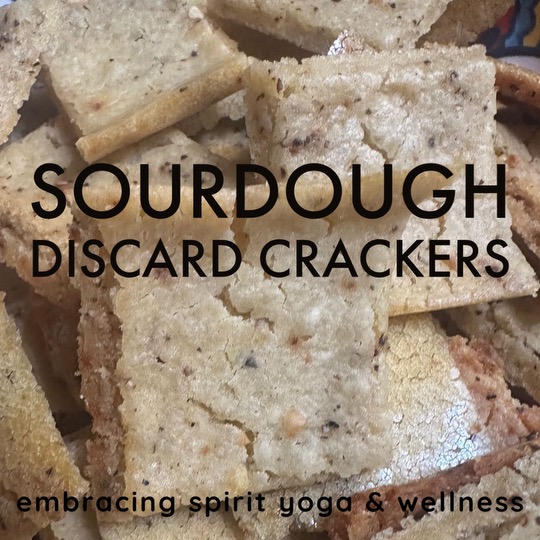
Sourdough Discard Crackers
Preheat the oven to 325 degrees.
In a small mixing bowl add 2-3 tablespoons of olive oil or melted butter. To this add seasonings you love. I have been adding Trader Joe’s 21 Seasoning Salutewhich is a smooth blend of onion, black pepper, celery seed, cayenne pepper, parsley, basil, marjoram, bay leaf, oregano, thyme, savory, rosemary, cumin, mustard, coriander, garlic, carrot, orange peel, tomato, lemon juice and lemon oil. The perfect savory flavor!
After combing the seasonings and oil, add 2 cups of sourdough discard and mix well.
Sprinkle Himalayan Pink Salt on top
Pour mixture onto a baking sheet lined with parchment paper
Bake for 10 minutes and then score into bite size squares with a pizza wheel
Bake an additional 20-30 minutes or until crispy and golden brown
I store these once cooled in a sealed container or jar (if they last that long)
Other combinations include parmesan cheese and rosemary or making an Italian herb blend flavor. Some people love the everything bagel flavor but I find smelling like garlic for days to be a slight downside. I saw someone also make cinnamon sugar crackers that were cut slightly smaller for a cereal type snack!
You might be able to see how this can easily become a part time obsession and finding new ways to use the discard is constantly fun.
Stacie believes that it is her life purpose to share the gift of Yoga with anyone who is willing to say yes. In addition to raising a family and being an advocate for those with disabilities, Stacie is founder of Embracing Spirit Yoga which specializes in bringing adaptive Yoga into community centers and rehabilitation clinics. Bringing her depth of compassion to the mat–or the chair–she offers students the opportunity to grow as an individual in all aspects of their life.
I thought I had it all figured out when it came to anticipating changes and challenges.
I chose the word vulnerability for 2023 and I thought I was done with being exposed emotionally, having to ask for help and all that other stuff that is so hard for me. Leaving 2023 behind, I was feeling pretty good about my progress in learning to be a little more exposed and willing to ask and receive help.
Little did I know that it was all just practice for the BIG time vulnerability.
For 2024, I opted to work on being okay regardless of what was going on. To be neutral in the midst of chaos and to not waiver when life gets challenging. I want to practice equanimity.
One week ago I had total hip replacement. I opted to go into the process solo knowing that I would be required to have a lot of help at home. My intention while at the hospital for three days was focusing on me. I felt pretty confident going home that I had myself ready. Preparing my house for time spent mostly on one level that has a bathroom and space for me to relax, ice and heal was key. Making sure I had snacks, books, pillows and all the things I felt I would need to limit the constant asking people to get things. I thought I was set.
In many ways I was and am set. Having done seven orthopedic surgeries in seven years prior to this one, I felt fairly confident in my ability to navigate pain, crutches and living in a tri-level house.
I had lots of things however that I did not anticipate. You can read all the articles on what to expect but until you are in it, there really isn’t a true frame of reference. And I will say again, hearing that 80 year olds have this procedure all the time and do great is so not helpful. Part of the gift of living a Yoga lifestyle is learning to truly practice not comparing yourself to anyone, including the 80 year olds that have been sedentary and usually already dependent on others and who will continue to be sedentary and dependent on others. Not the super active, busy changing lives, walking machine like me.
Anticipation is a great thing, until you miss a few things.
What I didn’t anticipate was the fracture in my femur that occurred during installation of my new hip joint. This meant my weight bearing status would be different and the need for that to heal, along with my new hip, would be harder and slower. Adding in the greatest fear ever of dislocation that can occur with one wrong move, I am on hyper alert when it comes to movement.
I also didn’t anticipate the helplessness that would come with the precautions of a total hip replacement. No bending or sitting part a 90 degree bend, no crossing the legs, no twisting the leg or hip internally. So that means pulling up your pants, putting on socks, shaving your legs, reaching for a blanket, dropping your phone, scratching an itch, lifting your leg onto the bed, and so much more. For someone who gets it all done effortlessly this is an abrupt stop to my life.
The simplest of things seem like an ordeal.
Then the WEDGE. The surgeon is very adamant about post-op precautions, especially with a fracture, and sleeping is the craziest thing ever. Between my legs is a large foam wedge that I have secured with four velcro straps to prevent any internal rotation. I also have my blood clot prevention pumpers pushing air in and out around my legs all night. Add in the compression socks that are so tight and itchy. All of this means that I am basically on my back, secured into one position for the night that I cannot get in or out by myself.
Talk about vulnerability.
Lying in bed while I am completely immobilized is the purest of vulnerability. What an opportunity to sit with equanimity and be neutral in the midst of emotional and physical restraint.
I also had no idea the volume of pain I would experience with this. I knew of course there would be pain but the deep, stabbing and burning pain around the joint is unreal. The fracture adds to the pain and the swelling has taken my once toned and slim leg back two decades when I weighed 80 pounds more. Looking down at my leg and seeing the size of my thigh is startling, but it is also temporary.
I know that this week has brought me so much in the form of grace and letting go. It has also invited me to receive like I have never received in my life.
For now, I am icing, walking, resting, and working on allowing the vulnerability to flood my daily experience while also accepting the equanimity that brings a steadiness to me.