Teaching Yoga From the Heart: How Intentional Yoga Themes Shape Practice and Life

Teaching From the Heart: How Intentional Yoga Themes Shape Our Practice—and Our Lives

There’s a quiet moment that happens before every class I teach. A pause. A breath. A soft tuning-in where I ask myself, What do my students need today? What do I need today?

For years, I have had the same monthly themes, and they flowed easily. Those familiar themes supported me through so much, but lately I’ve felt a deeper shift. A call to move beyond the patterns I’ve relied on… toward teaching with more intention, more presence, and a renewed sense of soulful planning.

It’s funny how yoga works like that.
We think we’re just choosing a theme, and suddenly we’re learning about ourselves.

When Teaching Themes Become Life Themes

What I’ve discovered is that choosing themes isn’t just about cueing a class. It’s about choosing the energy we want to cultivate—on the mat and beyond it.

When we guide students through grounding, we remember to root ourselves.
When we teach about softening, we start to release our own grip.
When we focus on balance, we begin noticing the places in our lives that feel uneven.

The themes we teach become tiny mirrors reflecting back what we, too, are navigating. And that’s the beauty of yoga—it never asks us to have it all figured out. It simply invites us to be awake to our experience.

Planning With Intention Isn’t Less Soulful—It’s More Meaningful

For a long time, I resisted planning too much. I prided myself on intuition, on feeling the energy in the room and following it. And there’s magic in that, yes. But now, as I grow and evolve, I understand something deeper:

Intentional planning doesn’t restrict the soul—it gives it a container to shine.

When we choose themes in advance, we’re not locking ourselves into rigidity. We’re choosing to approach our work with care. We’re giving our students consistency, nourishment, and continuity. And we’re giving ourselves a moment to pause, reflect, and ask:

What lesson is trying to be lived out here?

Practicing the Principles We Teach

Each time we create a theme, we apply the principles of yoga without even realizing it:

Ahimsa reminds us to choose gentle words.
Satya invites us to teach what feels honest.
Svadhyaya asks us to look inward as much as outward.
Tapas nudges us to stay committed, even when life feels heavy.
Santosha reminds us to find contentment in the simple act of showing up.

The way we plan is a practice.
The way we teach is a practice.
The way we live is a practice.

When we bring intention into our teaching, we naturally bring intention into our days. Our yoga themes become our reminders, our anchors, our quiet truths that follow us long after the class has ended.

A New Season of Teaching—and Living

As I move into this new season of teaching with greater intention, I’m reminded that yoga is always evolving us. It doesn’t just shape our bodies—it shapes our choices, our energy, our presence, our perspective.

And maybe that’s the real theme of all of this:

When we teach from a place of intention, we live from a place of intention.

And in that space?
Everything—your practice, your life, your purpose—begins to align with more clarity and more heart. I cannot wait to share each month’s theme with you!

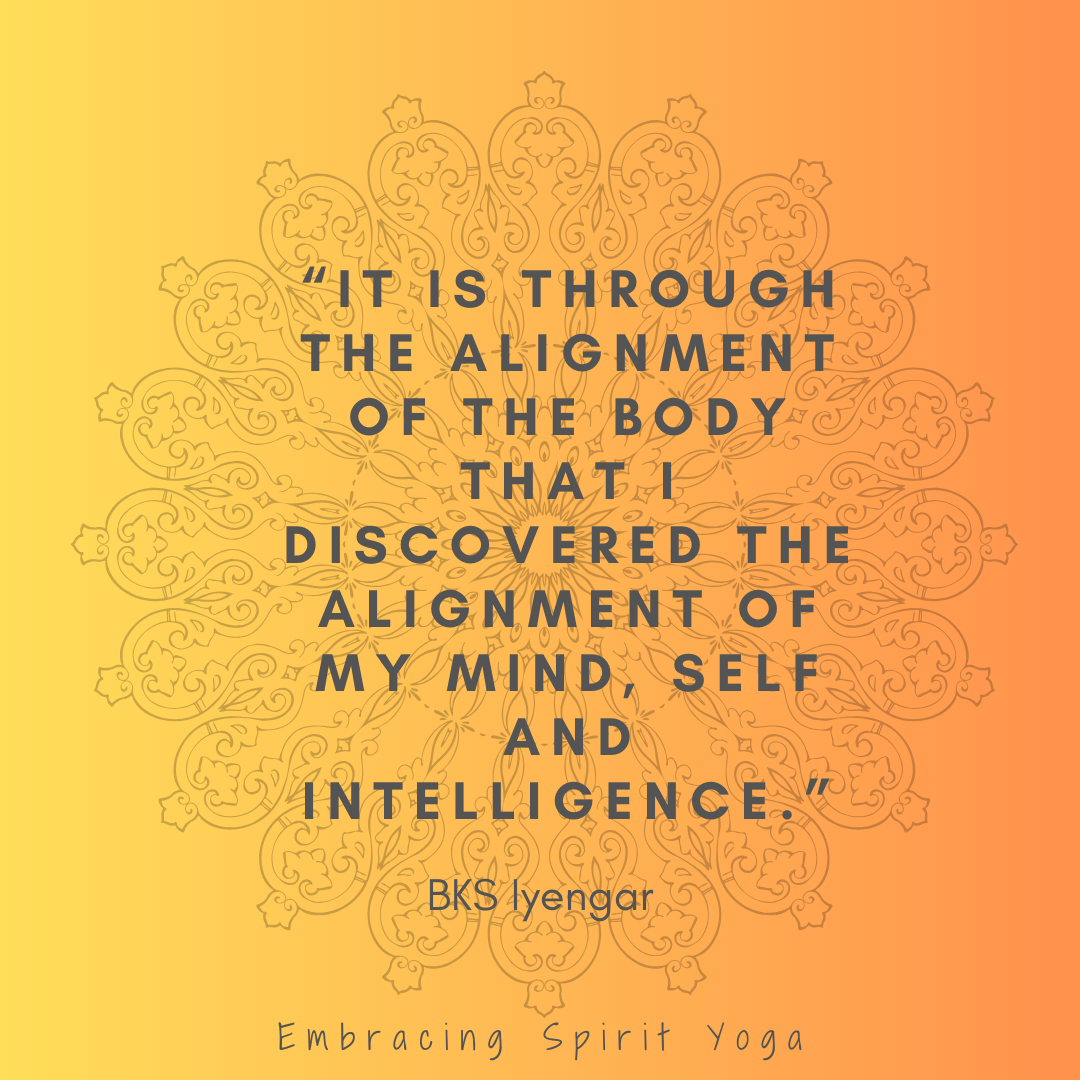
Alignment

When you hear the word alignment, what comes to mind? The dictionary defines alignment as arrangement in a straight line, or in correct or appropriate relative positions or  a position of agreement or alliance. This can mean a multitude of things as it relates to decisions we make, how we conduct ourselves, and even how we literally move our bodies in space.

To be “out of alignment” can be simply understood as an arrangement in which two or more things are not positioned correctly in a straight line or parallel to each other. In Yoga we hear a lot about the body being in alignment, but can that statement also relate to how you show up in the world?

Living Alignment

Remember last month I asked you to determine what makes up the roots or foundation that sustains you when life gets hard? Now it is time to put the proof in the pudding and see if your words, thoughts, and actions are in alignment with that.

Let’s say that integrity is a value you hold as something that keeps you steady. Then your actions dictate otherwise; you mislead people, you are a doormat for others to mislead you, you often fudge or hide the truth, or possibly you make decisions that are anything but ones packed with integrity. Simply thinking, if you say being healthy is important to you and you consume crappy food and toxic media, it is probable you are out of alignment with what you say you find important.

Alignment in Yoga

If you have been paying attention for long you may notice that I am big believer in living yoga and not just practicing yoga. I believe that far more of the yoga principles are implemented off the mat (or chair) and teach this all the time. The shape our bodies create while practicing is just a small part of it.

In Yoga, the principle of Alignment is closely related to principles like: balance, symmetry, precision and harmony – all are fundamental principles in yoga practice. Iyengar Yoga is the practice of precision. Poses are held for long periods and often modified with props. This method is designed to systematically cultivate strength, flexibility, stability, and awareness, and can be therapeutic for specific conditions. B.K.S. Iyengar, an Indian teacher and guru, founded Iyengar Yoga. Iyengar says:

Alignment is to bring balance between the flow of energy and intelligence to connect the body to the mind.” And then, he says “We adjust not the body, but the awareness. The moment the awareness is brought to function, then the body finds its right alignment and adjusts; as water finds its level, the awareness, too, finds its level.”

Having Awareness

Practicing yoga on the mat (or in chair) is a sure way to bring awareness to the language your body speaks. It invites you to pay close attention the nuances of the shape your body is in. It encourages you to listen and make adjustments along the way.

Imagine having this type of awareness in the thoughts you have? Or the words that you speak? How about the actions (or lack of) that you do everyday?

Putting the principles of alignment into your daily life following the “practice” will integrate the principles of this beautiful lifestyle into your life.

Join me on Youtube this month as I walk you through a weekly practice of alignment. There I will suggest ways to align yourself with what you said keeps you steady.

The Greatest Gift of Alignment

We have all had that magical feeling when everything in our life is flowing well. Our relationships are easy and fulfilling and we feel balanced. Or, when it seems that everything we attempt becomes a success. When life feels “easy” and we are rarely agitated by everyday things, it is likely we are in alignment. You might say it is as if you are in the beautiful flow of life where a gentle reciprocity exists in all areas.

This is the divine alignment. You are in it.