A Year of Renewal: Reflecting on Change, Courage, and New Beginnings

A Year of Renewal: Reflecting on Change, Courage, and New Beginnings

Every year, I choose a single word that becomes a thread woven through my life—my sankalpa, my heartfelt intention. This year, my word is Renewal, and as I close the door on another chapter, I can clearly see how life has been guiding me toward this exact moment of rediscovery.

2024 was unlike any year I’ve ever lived. It brought deep healing, unexpected shifts, and a powerful invitation to grow in directions I didn’t anticipate. After decades of helping others reconnect to themselves, this was the year life asked me to reconnect to me.

And I said yes.

Letting Go: Stepping Away After 18 Years

One of the biggest shifts—one that still feels surreal—was ending my 18 years of traveling to more than 50 assisted living homes. For nearly two decades, I poured my heart into teaching adaptive yoga, holding space for elders, and building community through mindful movement.

It was sacred work.
Beautiful work.
Exhausting work.

And it was time.

Pulling back to only a small handful of homes wasn’t just a schedule change. It was a soul-level shift. It was an act of honoring my body, my healing, and the next evolution of my service. For the first time in years, I allowed myself to loosen the grip on what I had always done and create space for what could be possible next.

A New Path: Becoming a Qualified Behavioral Health Assistant

This year also brought a huge professional pivot—one that aligned not only with my gifts but with my capacity.
I stepped into my new role as a Qualified Behavioral Health Assistant, helping people recover from trauma through skills, connection, and compassionate support.

This work is meaningful in a different way.
It requires less physical demand, but a deeper emotional presence.
It allows me to live my values without compromising my wellness.
And most of all, it lets me continue serving others in a way that honors my own healing journey.

Sometimes renewal doesn’t look like starting over.
Sometimes it looks like redirecting your wisdom where it can thrive.

Welcoming Rosie: Joy Arrives on Four Paws

Another bright spot this year?
I got a new puppy — sweet Rosie.

She arrived exactly when I needed a spark of uncomplicated joy, and she brought just that.
There is something magical about how animals help us stay present, soften our hearts, and remember to play. Rosie has been a daily reminder that renewal can show up in wagging tails, muddy paw prints, and early-morning snuggles.

She is a gift of pure delight.

The Big One: I Wrote My Book

And then there’s the part that still makes me say, “Did I really do that?”

I wrote my book.

After years of teaching, thousands of classes, countless conversations, and decades of lived experience… something inside me said now.
The words poured out—not from obligation, but from an inner knowing that it was time.

This book is the culmination of everything I’ve lived, learned, healed, and held.
It is a tapestry of wisdom and wellness, a snapshot of my heart in this season of life.
It is my offering.
My renewal.
My beginning again.

Writing it stretched me, surprised me, and awakened parts of my creativity that had been sleeping under the weight of survival mode. More than anything, it reminded me of my purpose—and my voice.

As I Step Into 2025

Renewal is not a return to who I used to be.
It’s an unfolding.
A softening.
A reclaiming.

This year brought endings, beginnings, and a lot of gentle in-between moments.
It taught me that clarity often arrives only after the letting go.
That healing isn’t linear.
That courage can be quiet.
And that renewal is a choice we make every single day.

As I step into 2025, I do so with gratitude, openness, trust and renewal.

My sankalpa of Renewal has been eye-opening and just rich. What is next? Stay tuned as I reveal my word for 2026! It is going to be a good one!

Karuna: Compassion in Action — How Mindful Compassion Transforms Your Life

Compassion in Action

Karuna is one of my favorite Sanskrit words. Often translated as compassion, its deeper meaning is so much richer. Karuna is compassion in motion — the kind of compassion that not only feels but responds. It is the moment when the heart whispers:
“I see your suffering, and I will meet it with love.”

Compassion doesn’t need to be grand. Most of the time, it’s quiet and ordinary. It lives in the small choices we make every day.

Karuna is the way we soften our tone when someone is tense.
Karuna is choosing not to take something personally.
Karuna is pausing before reacting.
Karuna is reaching out, even when we’re unsure what to say.
Karuna is treating ourselves as gently as we treat others.

In yoga philosophy, Karuna is one of the Brahmaviharas — the four heart qualities that guide us toward connection and ease. It reminds us that our compassion is not passive; it is embodied, lived, and expressed through action.

And the beautiful thing?
Karuna grows when we practice it.

When we offer compassion to someone else, we strengthen our own inner resilience. When we extend compassion toward ourselves, we become more available to others. It’s a cycle of generosity that feeds itself.

Today, I invite you to practice Karuna in one small way:

  • Offer a kind word to someone who seems overwhelmed.
  • Give yourself grace for something you’re carrying.
  • Check in on a friend who has been on your heart.
  • Interrupt a familiar stress pattern with one slow, mindful breath.
  • Choose a response rooted in care rather than reaction.

Compassion in action doesn’t change the whole world,
but it absolutely changes someone’s world.

And that is enough.

May your day be guided by Karuna —
gentle, courageous, and deeply human.

The Power of Authenticity: Staying True to Yourself in a World of Comparison

We live in a world that constantly invites us to compare — our bodies, our homes, our achievements, our happiness. The quiet scroll through social media can easily become a spiral of self-doubt, leaving us wondering if we measure up or if we’re enough.

But here’s the truth: you are not meant to be a copy of anyone else. The beauty of your life lies in the uniqueness of your story — your rhythms, your seasons, your way of seeing and being in the world.

Authenticity Over Approval

At our core, we all crave acceptance. It’s part of our human design — to be seen, to belong, to be loved. Yet, the line between being accepted and abandoning our authenticity can blur easily. We start shaping ourselves to fit expectations, dimming what makes us different in hopes of being liked or understood.

Authenticity asks something much deeper of us. It asks for courage. The courage to stand in our truth even when it feels uncomfortable or uncertain. It’s the willingness to show up — imperfectly, honestly, and wholly — and to trust that who we are is already enough.

Balancing Belonging and Being Real

Being authentic doesn’t mean rejecting connection or community. It means participating fully as yourself. It’s the sweet balance between honoring your truth and allowing others to honor theirs.

When we practice mindfulness, we learn to witness comparison as it arises — not with judgment, but with compassion. We can acknowledge the part of us that longs to belong, and gently remind it: belonging built on pretending isn’t belonging at all.

True connection comes when we bring our full selves to the table — our stories, scars, and quirks included.

Mindful Reflection: Coming Home to You

Take a quiet moment today to reflect:

  • When do you feel most like yourself?
  • Where in your life are you trying to fit in rather than be real?
  • What would authenticity look like — even in small ways — this week?

Allow your answers to guide you toward alignment.

The Freedom of Being You

When we stop comparing and start embracing, life softens. The noise quiets. We begin to live with more ease, purpose, and joy.

Authenticity doesn’t require us to be perfect — it simply invites us to be present and honest. And that is where peace truly lives.

Authenticity as a Yoga Practice

Yoga teaches us to return to our breath, to our bodies, and to the truth of the present moment. On the mat, there is no need to perform — only to feel and listen. Each breath becomes an invitation to come home to ourselves, just as we are.

When we carry that awareness off the mat, authenticity becomes a way of living — a mindful practice of choosing truth over image, compassion over comparison, and alignment over approval.

So, as you move through this season, may you permit yourself to be beautifully, unapologetically you. That is the most authentic gift you can give — to yourself and to the world.

Yoga Principles – The Yamas

My favorite example of what Yoga really is comes from my first Yoga teacher training. We learned the Yoga principles make up very important aspects to the practice. The teacher shared that Yoga is best described as a bicycle wheel where only one of the spokes on the wheel has to do with the body (asana), and the rest of the spokes is how we show up in the world.

What are the Yamas?

The Yamas are best described as five guidelines or principles in which we relate to others and the world around us. Another spoke of the wheel (the Niyamas) relate to our own personal guidelines and relating to the Self. When we understand and apply these guidelines to our life we can begin to see we are truly living our Yoga.

Ahimsa

(non-violence). When I first began practicing Yoga I thought ahimsa meant I had to give up eating meat, which I did for a while. It is actually much more than that. Violence begins in our thoughts and goes outward to our actions, and our words. Violence can also relate to how we treat the Earth. Our actions have profound effects on others and the world, so living a non violent way can impact people as well as animals and plants.

Satya

(truth). Satya is truthfulness, but it’s more than just telling the truth. The word ‘sat’ literally translates as ‘true essence’ or ‘unchangeable’.  One example of how living Satya exists is how we present ourselves to others and how we relate from the space of truth. For example, exaggerating facts to appear more extreme, or withholding facts to appear more pure, are acts that do not align with Satya. Also the thoughts about others and the stories we make up about others can relate to this Yama.

Asteya

(non stealing). We often think of stealing in the material sense, but this Yama is much more than that. To live asteya means we are mindful to not steal someone else’s grief by comparing it with our own grief. It also means that we do not steal someone’s celebration by becoming envious. Further, it is an honoring of one’s time and not “stealing” their resources to benefit us. Oh, and stealing their donut off their desk counts, too.

Brahmacharya

(moderation of the senses/right use of energy). In the ancient origins of Yoga this may have been interpreted as a form of celibacy, which no longer applies in our modern world of Yoga. Instead, this Yama actually can mean that we are aware of where we invest our energy. Another way to see this is directing our energy away from external desires and instead, towards finding peace and happiness within ourselves. Participating in drama and gossip is a form of energy that is not a useful place to invest in.

Aparigraha

(non-greed). This important Yama teaches us to take only what we need, keep only what serves us in the moment and to let go when the time is right. This can be in a literal sense as it relates to materialism but it can also lean towards a greediness of demands on someone else where expectations are high. Holding onto relationships, people, jobs, money and other areas can be a form of greed.

Reflecting on the Living the Yamas

We can learn that Yoga is much more than laying on the floor and creating shapes with our bodies. As we do, it is important to remember that while we are practicing the physical part of Yoga, we can infuse all of these Yamas into the time on the mat (or in a chair). For example, when we expect and demand that we have our “spot” in the yoga studio, or when we put too much focus on perfecting our headstand, or we push our bodies into pain we have just been harming, untruthful, greedy, and not using our energy appropriately.

I have much more to say on the Yamas here.

Follow me for more goodness!

About Stacie

Stacie believes that it is her life purpose to share the gift of Yoga with anyone who is willing to say yes. In addition to raising a family and being an advocate for those with disabilities, Stacie is founder of Embracing Spirit Yoga which specializes in bringing adaptive Yoga into community centers and rehabilitation clinics. Bringing her depth of compassion to the mat–or the chair–she offers students the opportunity to grow as an individual in all aspects of their life.

With over sixteen years experience, Stacie Wyatt is an experienced 500 hour Registered Yoga Teacher with Yoga Alliance, Certified Brain Injury Specialist, Certified Trauma Informed Coach, Life Wellness Coach, Senior YogaFit Instructor, Mind/Body Personal trainer, Stress Reduction and Meditation Instructor, Pilates Instructor, and Barre Instructor. Stacie is also certified in Integrative Movement Therapy™and is also a believer in the power and application of essential oils for health and wellness and proudly shares doTERRA essential oils.

If you love my content and want more tools for mindfulness & movement, check out my digital products on Buy Me a Coffee! Your support helps me continue creating. 

Alignment

When you hear the word alignment, what comes to mind? The dictionary defines alignment as arrangement in a straight line, or in correct or appropriate relative positions or  a position of agreement or alliance. This can mean a multitude of things as it relates to decisions we make, how we conduct ourselves, and even how we literally move our bodies in space.

To be “out of alignment” can be simply understood as an arrangement in which two or more things are not positioned correctly in a straight line or parallel to each other. In Yoga we hear a lot about the body being in alignment, but can that statement also relate to how you show up in the world?

Living Alignment

Remember last month I asked you to determine what makes up the roots or foundation that sustains you when life gets hard? Now it is time to put the proof in the pudding and see if your words, thoughts, and actions are in alignment with that.

Let’s say that integrity is a value you hold as something that keeps you steady. Then your actions dictate otherwise; you mislead people, you are a doormat for others to mislead you, you often fudge or hide the truth, or possibly you make decisions that are anything but ones packed with integrity. Simply thinking, if you say being healthy is important to you and you consume crappy food and toxic media, it is probable you are out of alignment with what you say you find important.

Alignment in Yoga

If you have been paying attention for long you may notice that I am big believer in living yoga and not just practicing yoga. I believe that far more of the yoga principles are implemented off the mat (or chair) and teach this all the time. The shape our bodies create while practicing is just a small part of it.

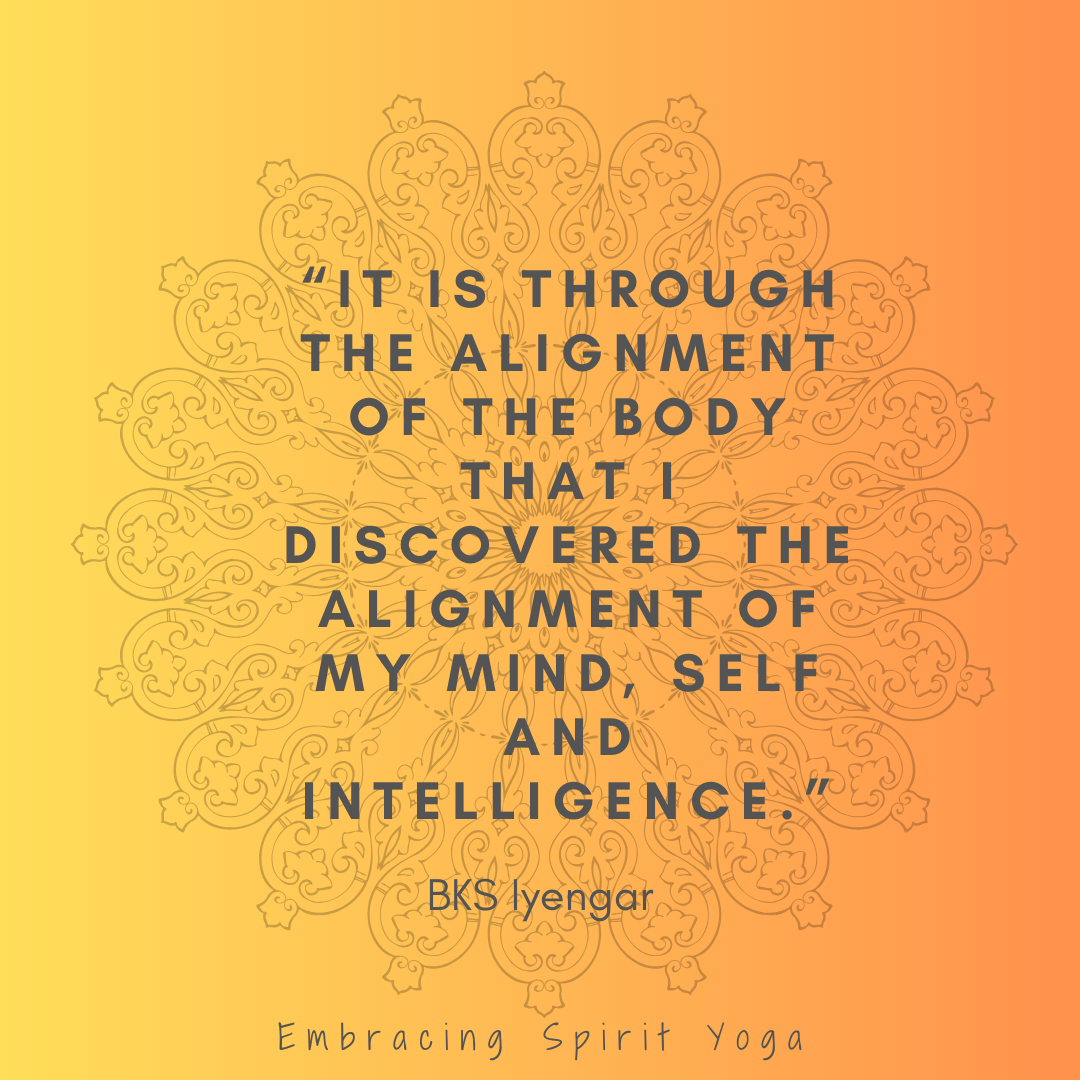
In Yoga, the principle of Alignment is closely related to principles like: balance, symmetry, precision and harmony – all are fundamental principles in yoga practice. Iyengar Yoga is the practice of precision. Poses are held for long periods and often modified with props. This method is designed to systematically cultivate strength, flexibility, stability, and awareness, and can be therapeutic for specific conditions. B.K.S. Iyengar, an Indian teacher and guru, founded Iyengar Yoga. Iyengar says:

Alignment is to bring balance between the flow of energy and intelligence to connect the body to the mind.” And then, he says “We adjust not the body, but the awareness. The moment the awareness is brought to function, then the body finds its right alignment and adjusts; as water finds its level, the awareness, too, finds its level.”

Having Awareness

Practicing yoga on the mat (or in chair) is a sure way to bring awareness to the language your body speaks. It invites you to pay close attention the nuances of the shape your body is in. It encourages you to listen and make adjustments along the way.

Imagine having this type of awareness in the thoughts you have? Or the words that you speak? How about the actions (or lack of) that you do everyday?

Putting the principles of alignment into your daily life following the “practice” will integrate the principles of this beautiful lifestyle into your life.

Join me on Youtube this month as I walk you through a weekly practice of alignment. There I will suggest ways to align yourself with what you said keeps you steady.

The Greatest Gift of Alignment

We have all had that magical feeling when everything in our life is flowing well. Our relationships are easy and fulfilling and we feel balanced. Or, when it seems that everything we attempt becomes a success. When life feels “easy” and we are rarely agitated by everyday things, it is likely we are in alignment. You might say it is as if you are in the beautiful flow of life where a gentle reciprocity exists in all areas.

This is the divine alignment. You are in it.

Yoga Principles – The Yamas

My favorite example of what Yoga really is comes from my first Yoga teacher training. We learned the Yoga principles make up very important aspects to the practice. The teacher shared that Yoga is best described as a bicycle wheel where only one of the spokes on the wheel has to do with the body (asana), and the rest of the spokes is how we show up in the world.

What are the Yamas?

The Yamas are best described as five guidelines or principles in which we relate to others and the world around us. Another spoke of the wheel (the Niyamas) relate to our own personal guidelines and relating to the Self. When we understand and apply these guidelines to our life we can begin to see we are truly living our Yoga.

Ahimsa

(non-violence). When I first began practicing Yoga I thought ahimsa meant I had to give up eating meat, which I did for a while. It is actually much more than that. Violence begins in our thoughts and goes outward to our actions, and our words. Violence can also relate to how we treat the Earth. Our actions have profound effects on others and the world, so living a non violent way can impact people as well as animals and plants.

Satya

(truth). Satya is truthfulness, but it’s more than just telling the truth. The word ‘sat’ literally translates as ‘true essence’ or ‘unchangeable’.  One example of how living Satya exists is how we present ourselves to others and how we relate from the space of truth. For example, exaggerating facts to appear more extreme, or withholding facts to appear more pure, are acts that do not align with Satya. Also the thoughts about others and the stories we make up about others can relate to this Yama.

Asteya

(non stealing). We often think of stealing in the material sense, but this Yama is much more than that. To live asteya means we are mindful to not steal someone else’s grief by comparing it with our own grief. It also means that we do not steal someone’s celebration by becoming envious. Further, it is an honoring of one’s time and not “stealing” their resources to benefit us. Oh, and stealing their donut off their desk counts, too.

Brahmacharya

(moderation of the senses/right use of energy). In the ancient origins of Yoga this may have been interpreted as a form of celibacy, which no longer applies in our modern world of Yoga. Instead, this Yama actually can mean that we are aware of where we invest our energy. Another way to see this is directing our energy away from external desires and instead, towards finding peace and happiness within ourselves. Participating in drama and gossip is a form of energy that is not a useful place to invest in.

Aparigraha

(non-greed). This important Yama teaches us to take only what we need, keep only what serves us in the moment and to let go when the time is right. This can be in a literal sense as it relates to materialism but it can also lean towards a greediness of demands on someone else where expectations are high. Holding onto relationships, people, jobs, money and other areas can be a form of greed.

Reflecting on the Living the Yamas

We can learn that Yoga is much more than laying on the floor and creating shapes with our bodies. As we do, it is important to remember that while we are practicing the physical part of Yoga, we can infuse all of these Yamas into the time on the mat (or in a chair). For example, when we expect and demand that we have our “spot” in the yoga studio, or when we put too much focus on perfecting our headstand, or we push our bodies into pain we have just been harming, untruthful, greedy, and not using our energy appropriately.

I have much more to say on the Yamas here.

Follow me for more goodness!

About Stacie

Stacie believes that it is her life purpose to share the gift of Yoga with anyone who is willing to say yes. In addition to raising a family and being an advocate for those with disabilities, Stacie is founder of Embracing Spirit Yoga which specializes in bringing adaptive Yoga into community centers and rehabilitation clinics. Bringing her depth of compassion to the mat–or the chair–she offers students the opportunity to grow as an individual in all aspects of their life.

With over sixteen years experience, Stacie Wyatt is an experienced 500 hour Registered Yoga Teacher with Yoga Alliance, Certified Brain Injury Specialist, Certified Trauma Informed Coach, Life Wellness Coach, Senior YogaFit Instructor, Mind/Body Personal trainer, Stress Reduction and Meditation Instructor, Pilates Instructor, and Barre Instructor. Stacie is also certified in Integrative Movement Therapy™and is also a believer in the power and application of essential oils for health and wellness and proudly shares doTERRA essential oils.

Principles of Yoga

In order to grow we must first remove what it is in the way.

The Eight Limbs of Yoga–the Niyamas

Patanjali, creator of the Yoga Sutra, wrote about how the practice of Yoga contains 8 “limbs”. These principles of Yoga have become the map for which we direct our lives. The Yamas and the Niyamas are the first two limbs and help guide us to being the best version of ourselves. The yamas are guidelines for how to operate in society, while the niyamas show how to elevate our inner being.

The principle Suacha is the second Niyama. It is loosely defined as cleanliness or purity. I believe this is a time more than ever for Suacha. The post pandemic opinions that run rampant AND it being a presidential election year this may be a LOUD cry for a radical practice of Suacha, (that may be a little dramatic…). Sometimes we get so clouded by the opinions of others and the internal response that it gives us, that we struggle to remember what is our own truth because it becomes so muddied with clutter and then uncertainty.

What is the principle called Suacha?

Suacha is a principle in which we literally clean up our lives, and I believe this all starts with our thoughts. If our inner landscape is a mess, it is likely the rest of life follows suit. Relationships are probably splintered, and our general happiness may be clouded if our inner world is cluttered. This principle encourages us to watch the unclean thoughts that enter into our mind–fear, worries, competition, anger and more.

Of course this also can mean making time for cleaning up our environment. When our living space is orderly and tidy, it is likely we will feel more grounded and clear. The level of tidiness in our outer world can also make a substantial difference in how you feel. When your rooms are tidy, it has an influence on your unconscious. I love to think about a garden this time of year. We might see the beginnings of green shoots but we also see all of last years growth laying on top and around the attempt of new growth. In order for the green stuff to grow into amazing beauty, we must first pull out and throw away all of the old material that is in the way. Imagine if we got rid of the old stuff in our and heads and hearts? Feelings like bitterness, old hurts, regrets, shame and even the past. Without all that “stuff” in the way, it is likely you may have some amazing growth!

This is a pivotal time in our own responsibility to ask ourselves hard questions. 

Ask your self this:

What is seeking to be released or cleansed from the very essence of our beings? What mental and emotional patterns are no longer serving us? Is there something seeking to be cleansed on a micro (individual) and macro (global) level? How can we get curious about this deeper meaning?

Here are some tips to allow the principle of Suacha to become part of your practice for living your best life:

  • To cleanse the mind, meditate, pray and/or journal for 10–20 minutes each day
  • To purify the body, Practice yoga for 30+ minutes few times a week
  • Sweat out those toxins–go for a hike, ride your bicycle, MOVE
  • Doodle in a journal and let your creative side process your feelings
  • Clean your entire home at least once a week
  • Burn incense, lay your crystals out in the moon, diffuse oils
  • Acknowledge all your emotions, positive and negative write them down, then tear the paper and release it.
  • Trust your intuition, it will guide you on what are the best Suacha practices for YOU

The principle suacha invites each of us to look at practicing a deep, soul cleansing. This is a time to ask ourselves what is bringing clutter into our hearts and minds. Is it the media? The gossiping and negativity? The division we witness in our current world is evident as an apparent onslaught of emotions that clog the veins that lead to our spiritual self. And in turn we have become hardened, angry, tarnished souls with little compassion for each other.

This is not a one time thing or even a springtime thing. Suacha, like Yoga, is a way of being.

About Stacie

With over sixteen years experience, Stacie Wyatt is an experienced 500 hour Registered Yoga Teacher with Yoga Alliance, Certified Brain Injury Specialist, Certified Trauma Informed Coach, Life Wellness Coach, Senior YogaFit Instructor, Mind/Body Personal trainer, Stress Reduction and Meditation Instructor, Pilates Instructor, and Barre Instructor. Stacie is also certified in Integrative Movement Therapy™and is also a believer in the power and application of essential oils for health and wellness and proudly shares doTERRA essential oils.