Alignment

When you hear the word alignment, what comes to mind? The dictionary defines alignment as arrangement in a straight line, or in correct or appropriate relative positions or  a position of agreement or alliance. This can mean a multitude of things as it relates to decisions we make, how we conduct ourselves, and even how we literally move our bodies in space.

To be “out of alignment” can be simply understood as an arrangement in which two or more things are not positioned correctly in a straight line or parallel to each other. In Yoga we hear a lot about the body being in alignment, but can that statement also relate to how you show up in the world?

Living Alignment

Remember last month I asked you to determine what makes up the roots or foundation that sustains you when life gets hard? Now it is time to put the proof in the pudding and see if your words, thoughts, and actions are in alignment with that.

Let’s say that integrity is a value you hold as something that keeps you steady. Then your actions dictate otherwise; you mislead people, you are a doormat for others to mislead you, you often fudge or hide the truth, or possibly you make decisions that are anything but ones packed with integrity. Simply thinking, if you say being healthy is important to you and you consume crappy food and toxic media, it is probable you are out of alignment with what you say you find important.

Alignment in Yoga

If you have been paying attention for long you may notice that I am big believer in living yoga and not just practicing yoga. I believe that far more of the yoga principles are implemented off the mat (or chair) and teach this all the time. The shape our bodies create while practicing is just a small part of it.

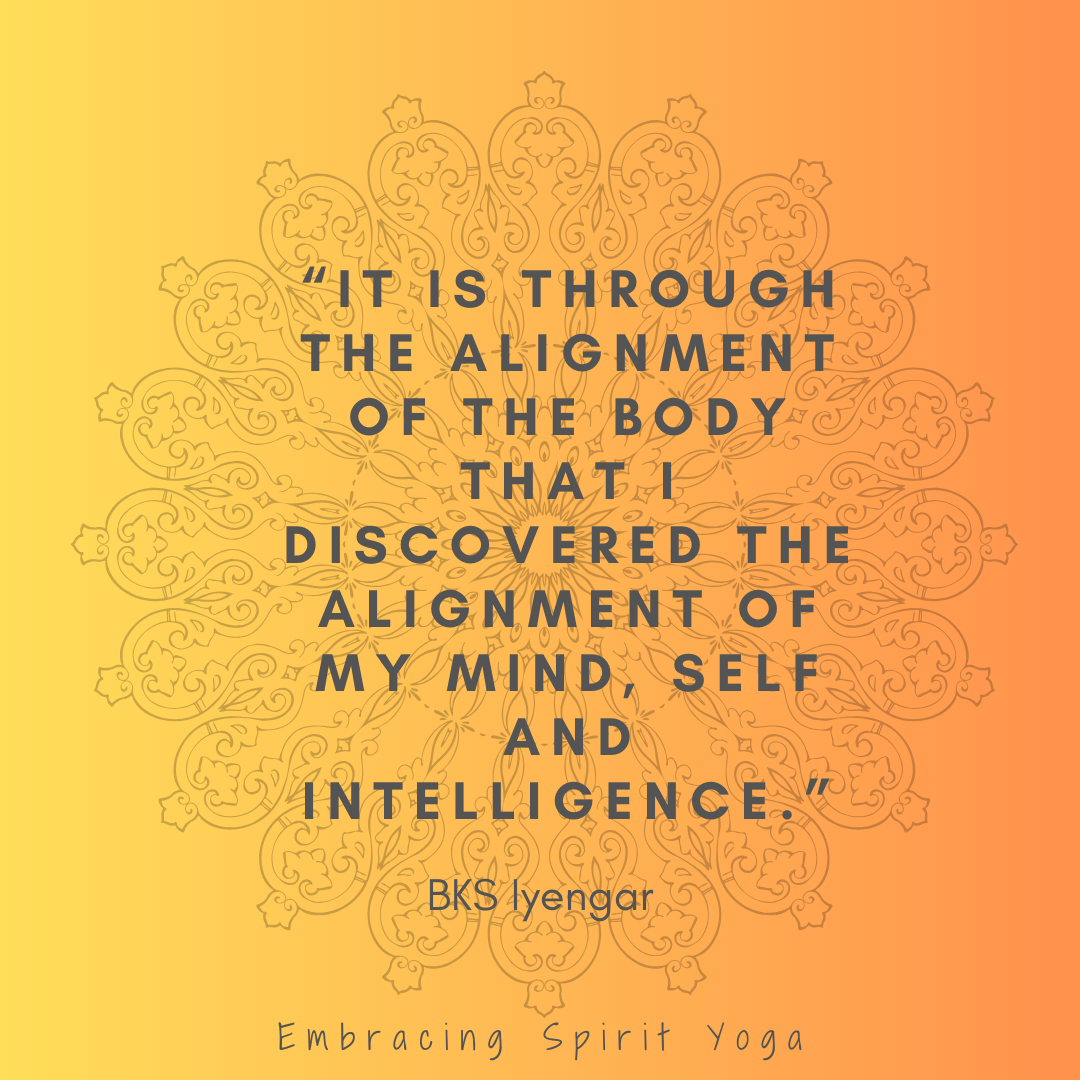
In Yoga, the principle of Alignment is closely related to principles like: balance, symmetry, precision and harmony – all are fundamental principles in yoga practice. Iyengar Yoga is the practice of precision. Poses are held for long periods and often modified with props. This method is designed to systematically cultivate strength, flexibility, stability, and awareness, and can be therapeutic for specific conditions. B.K.S. Iyengar, an Indian teacher and guru, founded Iyengar Yoga. Iyengar says:

Alignment is to bring balance between the flow of energy and intelligence to connect the body to the mind.” And then, he says “We adjust not the body, but the awareness. The moment the awareness is brought to function, then the body finds its right alignment and adjusts; as water finds its level, the awareness, too, finds its level.”

Having Awareness

Practicing yoga on the mat (or in chair) is a sure way to bring awareness to the language your body speaks. It invites you to pay close attention the nuances of the shape your body is in. It encourages you to listen and make adjustments along the way.

Imagine having this type of awareness in the thoughts you have? Or the words that you speak? How about the actions (or lack of) that you do everyday?

Putting the principles of alignment into your daily life following the “practice” will integrate the principles of this beautiful lifestyle into your life.

Join me on Youtube this month as I walk you through a weekly practice of alignment. There I will suggest ways to align yourself with what you said keeps you steady.

The Greatest Gift of Alignment

We have all had that magical feeling when everything in our life is flowing well. Our relationships are easy and fulfilling and we feel balanced. Or, when it seems that everything we attempt becomes a success. When life feels “easy” and we are rarely agitated by everyday things, it is likely we are in alignment. You might say it is as if you are in the beautiful flow of life where a gentle reciprocity exists in all areas.

This is the divine alignment. You are in it.

Autumn Equinox

The Autumn Equinox is a time of letting go and harvesting the good that is abundant in our lives. To allow the stalks and leaves to fall aside and go back to the Earth. With this beautiful and colorful season emerging it is our time to loosen our grip on the focus of growth and prepare to move into a more dormant season.

Autumn Equinox and cycles 

This is also a great time to look at the cycles of life; seasons, months, breath, and even life. As we embrace the time of gathering our harvest we are also preparing ourselves for the cycle in which we become more hunkered down. A little more in hibernation mode. The paradox of understanding cycles exists everywhere. 

The simplest observation is the breath; to inhale you must also exhale.

When we are awake we come to know that with each ending there is a beginning in whatever shape that takes; self awareness, growth, wisdom, letting go, forgiveness and grief.  If we pay attention, we can see this so easily in the changing of leaves. The amazing color that emerges following a season of bounty. Then the ease in which the leaf lets go. Watch as leaves effortlessly fall to the ground. They are taken into the loving arms of Mother Earth for the new growth that waits for the next season.

Take time to look at letting go of what no longer serves you.

At the autumn equinox there is a dynamic shift. The season of sunshine, growth, taking action, movement to a more quiet and still season. This time of year during the equinox is a powerful time to pause after the often chaotic energy of summer. Back to school and busy-ness to a more dormant and contemplative time.

This is time where we replenish, regenerate and recuperate from a season of push. 

Well, at least we should try to as the we are so in tune with nature and the natural rhythms of the world, if we are paying attention. Nature responds to the lessening hours of daylight by slowly fading into dormancy. Watch as the leaves fall from trees, the lush green of shrubs and vegetation fades, and animals forage and gather for a season of hibernation. How do we mimic these natural occurrences? We withdraw from the rush of outward action to a season of a more contemplative inner reflection of our spirit.

With this season also comes a wonderful reminder to gather your harvests and share with others and to celebrate the abundance of the world with your neighbors, your family, or even a stranger. We tend to want to hang on to “things”, both tangible and intangible and really all that does is is exhaust us and stop the flow of goodness.

During a yoga practice watch as you move in and out of balance and neutral. How your breath becomes rapid and slow, though we strive for equality of breath. Notice how the tension in our body is often paired with ease. Thoughts come and thoughts go.

The skills that we learn on the yoga to find neutral, equanimity, and harmony teach us the gift of following the rhythm of nature. Remember, our time on the mat is truly a practice for living yoga as we know that yoga really happens off the mat. 

Our practice this time of year should reflect the message of the equinox and allow it to be filled with times of pausing to gather your breath, to reflect in mountain pose with a sense of neutrality and to find the balance between dynamic postures and stillness.

Welcome the harvest that is within and always look for opportunities to be grateful.

 I know for myself, the practice of gratitude has lead me into a life of awareness that has enhanced my life everyday.

Life is really good, friends.


About Stacie

Stacie believes that it is her life purpose to share the gift of Yoga with anyone who is willing to say yes. In addition to raising a family and being an advocate for those with disabilities, Stacie is founder of Embracing Spirit Yoga which specializes in bringing adaptive Yoga into community centers and rehabilitation clinics. Bringing her depth of compassion to the mat–or the chair–she offers students the opportunity to grow as an individual in all aspects of their life.

With over sixteen years experience, Stacie Wyatt is an experienced 500 hour Registered Yoga Teacher with Yoga Alliance, Certified Brain Injury Specialist, Certified Trauma Informed Coach, Life Wellness Coach, Senior YogaFit Instructor, Mind/Body Personal trainer, Stress Reduction and Meditation Instructor, Pilates Instructor, and Barre Instructor. Stacie is also certified in Integrative Movement Therapy™and is also a believer in the power and application of essential oils for health and wellness and proudly shares doTERRA essential oils.

Self Reflection

Self-reflection is a humbling process. It’s essential to find out why you think, say, and do certain things…. then better yourself.

How much time do you spend self reflecting? Do you ever hit the pause button and reflect on your decisions for the year and if they are aligned with your goals or visions for your life?

We are headed into the final quarter of the year and it is a good time to reflect on your beginning of the year visions and see how they have evolved and what you can do in the final stretch to reach them.

Equanimity

I set out the year with a quest to live with equanimity. To be steady and unwavering no matter what shows up. I should have known to be careful what I wish for. What a year it has been. I had two major hip surgeries and an infection in the hip. Add in some horrific reactions to the medications to treat the infection AND blood clots in my arm that resulted in permanent damage to the veins.

Despite it all, with the exception of a few days where I struggled to see beyond the pain, I feel that I did a great job maintaining equanimity as it is defined: evenness of mind especially under stress… a calm mental state and without hurried movementright disposition or balance.

Self Reflection

Reflecting on the year is a great way to see the actual tools and actions that were put into place to lean towards your goal. Where did you grow and what is left to do?

I dug into some new things and discovered quite a bit about myself.

How did I remain steady and unwavering given all that this year asked me to face?

Learning a new skill can be a great way to redirect your mind away from what ails you to a new place of curiosity and challenge. I took on learning how to bake sourdough bread, canning jams and jellies and more.

Getting creative is a great way to bring happiness to your life if you are struggling. I opted to use a fun digital planner to help me create a system of graphics and ideas for my YouTube channel. I also found joy in creating homemade body butters, lotions and serums.

Participating in education and classes uses a part of your brain that can ignite interests in other areas. I explored a variety of free online courses to keep my brain working and sharp while my body healed.

Being outside does wonders for our mental health. Whether it is caring for a simple garden, sitting under a tree or basking in some sunshine, it all helps.

Gratitude is proven to be a tool that can truly change your life. When you practice gratitude, you shift your thoughts away from negative emotions and uncomfortable sensations. A daily heartfelt gratitude practice is a must.


What will you do in these final few months of 2024 to come closer to your vision?

How can I support you? Look at my podcast for past and upcoming episodes that dive deep into this.

The Foundation

It is not the beauty of a building you should look at; it’s the construction of the foundation that will stand the test of time. ~ David Allen Coe

This time of year is ideal for getting back into ourselves after a summer season of play, vacations, kids home, and way less structure. This is the time where we reclaim our sense of self and rediscover the aspects of ourselves that support us in our everyday life. 

As you experience a more predictable schedule and life begins to resume some sort of normalcy, take a few minutes to consider the four walls, or four main roots of a tree, that represent your foundation. This is the scaffolding which supports all the other parts of our home, or tree, during times of turbulence. 

Here are some ideas– faith, service, accountability, kindness, diligence, love, fulfillment, action, compassion, determination, optimism, etc. 

Take a listen to this short podcast on how this powerful understanding can bring much stability to your life.

Foundation Essential Oil Blend

You may know if you stop here often that I believe in the power of aroma to shift our chemical response in our brain. We can influence our state of arousal and our emotional state simply by smelling something. How cool is that?

Not sure where to start? Grab one of these blends, take 4-5 deep breaths, apply it to your spine and under your nose and then listen. You already know…now, you just need to listen.

By the way, check out the emotional benefits of these oils:

  • Douglas Fir.This one invites you to invoke your high wisdom and learn from the past experiences and people who may have crossed your path. This essential oil is perfect for turning inward in the season of more introspection.
  • Frankincense.Frankincense asks you to welcome in feelings of protection, wisdom, discernment, and a spiritual awakening. This sacred essential oil invites individuals to shed the lower vibration feelings that are often negative and draining. This truly brings our your own magnificence.
  • Ho Wood. This peaceful oil brings out a sense of calm and helps to quiet the mind. By clearing the mind of anxious thoughts or simply clutter, we can fine tune into the deepest parts of who we are. This helps us to live in alignment with our principles and aspects of our foundation. 
  • Blue Tansy. This one is a powerful aroma that helps to bring out inspiration and the committed response of tacking action. This helps to be more purposeful and responsible, which is such a beautiful aspect to a solid constitution. Blue tansy welcomes in a sense of freedom and sense of walking towards your deepest dreams and desires. 
  • Blue Chamomile.This sweet and delicate flower is commonly known as German chamomile and offers a beautiful blue hue to the oil. Like its counter part Roman Chamomile, this flower oil is the perfect choice for bringing out a peaceful and serene mental state. This brings out emotional harmony and illuminates the wisdom with your soul.
  • Spruce. This stable, grounded aroma brings out an enduring balanced outlook to life while also giving strength through your wisdom. When we soak in this aroma we are reminded of the rhythms and ancient wisdom the earth offers. 
  • Cassia. This bold oil which a friend of cinnamon is warm and earthy as it invites you to feel courageous, strong, self-assured and confident in your authentic self. This brings an embracing warmth to the confident and meaningful connections in our life. 
  • Petrified Wood Chips. It helps to create balance and offers a foundation from which to launch new goals or undertake a different path. This grounding stone helps to calm scattered energies and look closely at the essence of what guides our decisions.

These beautiful oils and solid gemstones will be a constant as your dive into the fall season of a slower pace, a calmer mind, and as you seek out the principles in which your life is sustained by. To learn more about the principles I have chosen for myself, check out this blog post.

You can purchase this blend here and it will soon arrive in your mailbox with lots of grounding love.

Yoga Principles – The Yamas

My favorite example of what Yoga really is comes from my first Yoga teacher training. We learned the Yoga principles make up very important aspects to the practice. The teacher shared that Yoga is best described as a bicycle wheel where only one of the spokes on the wheel has to do with the body (asana), and the rest of the spokes is how we show up in the world.

What are the Yamas?

The Yamas are best described as five guidelines or principles in which we relate to others and the world around us. Another spoke of the wheel (the Niyamas) relate to our own personal guidelines and relating to the Self. When we understand and apply these guidelines to our life we can begin to see we are truly living our Yoga.

Ahimsa

(non-violence). When I first began practicing Yoga I thought ahimsa meant I had to give up eating meat, which I did for a while. It is actually much more than that. Violence begins in our thoughts and goes outward to our actions, and our words. Violence can also relate to how we treat the Earth. Our actions have profound effects on others and the world, so living a non violent way can impact people as well as animals and plants.

Satya

(truth). Satya is truthfulness, but it’s more than just telling the truth. The word ‘sat’ literally translates as ‘true essence’ or ‘unchangeable’.  One example of how living Satya exists is how we present ourselves to others and how we relate from the space of truth. For example, exaggerating facts to appear more extreme, or withholding facts to appear more pure, are acts that do not align with Satya. Also the thoughts about others and the stories we make up about others can relate to this Yama.

Asteya

(non stealing). We often think of stealing in the material sense, but this Yama is much more than that. To live asteya means we are mindful to not steal someone else’s grief by comparing it with our own grief. It also means that we do not steal someone’s celebration by becoming envious. Further, it is an honoring of one’s time and not “stealing” their resources to benefit us. Oh, and stealing their donut off their desk counts, too.

Brahmacharya

(moderation of the senses/right use of energy). In the ancient origins of Yoga this may have been interpreted as a form of celibacy, which no longer applies in our modern world of Yoga. Instead, this Yama actually can mean that we are aware of where we invest our energy. Another way to see this is directing our energy away from external desires and instead, towards finding peace and happiness within ourselves. Participating in drama and gossip is a form of energy that is not a useful place to invest in.

Aparigraha

(non-greed). This important Yama teaches us to take only what we need, keep only what serves us in the moment and to let go when the time is right. This can be in a literal sense as it relates to materialism but it can also lean towards a greediness of demands on someone else where expectations are high. Holding onto relationships, people, jobs, money and other areas can be a form of greed.

Reflecting on the Living the Yamas

We can learn that Yoga is much more than laying on the floor and creating shapes with our bodies. As we do, it is important to remember that while we are practicing the physical part of Yoga, we can infuse all of these Yamas into the time on the mat (or in a chair). For example, when we expect and demand that we have our “spot” in the yoga studio, or when we put too much focus on perfecting our headstand, or we push our bodies into pain we have just been harming, untruthful, greedy, and not using our energy appropriately.

I have much more to say on the Yamas here.

Follow me for more goodness!

About Stacie

Stacie believes that it is her life purpose to share the gift of Yoga with anyone who is willing to say yes. In addition to raising a family and being an advocate for those with disabilities, Stacie is founder of Embracing Spirit Yoga which specializes in bringing adaptive Yoga into community centers and rehabilitation clinics. Bringing her depth of compassion to the mat–or the chair–she offers students the opportunity to grow as an individual in all aspects of their life.

With over sixteen years experience, Stacie Wyatt is an experienced 500 hour Registered Yoga Teacher with Yoga Alliance, Certified Brain Injury Specialist, Certified Trauma Informed Coach, Life Wellness Coach, Senior YogaFit Instructor, Mind/Body Personal trainer, Stress Reduction and Meditation Instructor, Pilates Instructor, and Barre Instructor. Stacie is also certified in Integrative Movement Therapy™and is also a believer in the power and application of essential oils for health and wellness and proudly shares doTERRA essential oils.

Is Yoga Just Exercise?

Consider for yourself if you view Yoga as exercise? Is it? Is Yoga something you “do”? Or, is Yoga much more than exercise?

Big questions with a really simple answer. First of all, the majority of us do in fact come to a Yoga class looking for some sort of physical enhancement; to be more toned, to have greater flexibility, to be more coordinated, to support aches and pains naturally or a variety of other reasons. I get that. I did, too. When I first started practicing Yoga it was purely from the standpoint of exercise and my reasoning is that I wanted to be more flexible.

Then it happened. Not only did I gain flexibility physically but my mind and heart also became quite flexible in the process.

Is Yoga Exercise?

According to Medline, Yoga is a practice that connects the body, breath, and mind. It uses physical postures, breathing exercises, and meditation to improve overall health. Yoga was developed as a spiritual practice thousands of years ago. Today, most Westerners who do yoga do it for exercise or to reduce stress.

Was that the intent of Yoga when it was discovered?

The word ‘Yoga’ is derived from the Sanskrit root ‘Yuj’, meaning ‘to join’ or ‘to yoke’ or ‘to unite’. As per Yogic scriptures the practice of Yoga leads to the union of individual consciousness with that of the Universal Consciousness, indicating a perfect harmony between the mind and body.

Through learning about the 8 Limbs of Yoga we begin to see this is much more than a physical practice that our Western minds have adopted.

What are the 8 Limbs of Yoga?

  • YAMA – Restraints, moral disciplines or moral vows.
  • NIYAMA – Positive duties or observances.
  • ASANA – Posture of the body.
  • PRANAYAMA – Breathing Techniques.
  • PRATYAHARA – Sense withdrawal.
  • DHARANA – Focused Concentration.
  • DHYANA – Meditative Absorption.
  • SAMADHI – Bliss or Enlightenment.

You see, if the 8 limbs of Yoga were the spokes of a bicycle wheel, only one spoke would have anything to do with the physical body.

Why does learning about the other 7 limbs matter?

For some people exercise is all they want, and that is fine. I just am hesitant to call it Yoga. To me, Yoga is a lifestyle and a series of attitudes and principles that we embody to create wholeness in the mind, body and spirit. When this happens, we actually begin to influence the people around us in a more positive way. Way more positive than being able to hold a plank for three minutes or lift super heavy weights if you ask me. I would rather know that the way I am showing up in the world is bettering the people around me. We practice showing up on the mat, and apply it to our life off the mat.

When I was raising children, my oldest and youngest boys got to experience two very different childhoods as it relates to the influence Yoga had on me. As a result it also influenced them. My oldest son had more years of being influenced by a highly reactive, stressed, angry and overly emotional mom. My youngest on the other hand, had a longer period of his formative years with a present, calm and peaceful mom. While each son is their own personality and preferences, they do have a dynamically different outlook on life and I do attribute some of that to their primary caregiver (me) having gone through the transformative change that Yoga can bring to one’s life.

Can we just see Yoga as an exercise and still be ok?

Absolutely. 100%. Yes. I would just ask that if you choose to practice Yoga, you consider also learning about the other equally important limbs of the practice. You just might see how amazing it can be, beyond the body.

I have lots more to say on this. Take a listen!

Living with Chronic Pain

Living with chronic pain can feel overwhelming but when you put a few tools into your toolbox you can start to feel empowered versus defeated. I have found combining traditional treatment with some holistic approaches is the perfect balance for living with chronic pain.

When I was first referred to a pain management specialist I was in my mid-thirties and had no real idea what it all meant. I knew that I was there to address chronic and ongoing back pain but was a little clueless about empowering myself with a few tools to help manage the pain. Over time I have gathered quite a bit of knowledge and found what works for me.

Tools for Living with Chronic Pain

A holistic approach to living with chronic pain means you bring together a variety of tools to help support you. Being open to trying things is key when looking for the right tool for you. Here are my top four tools in my toolbox.

Gratitude

Please don’t skip past this part because you think that there is no way gratitude can help your physical pain. Hear me out. Gratitude CAN in fact reroute your thinking from dwelling on pain to a better place. Get yourself a small notebook, a free app, or a document section on your computer and start with 3-5 things each day you are thankful for, and why. Listing off your family, friends, house and dog is fine and dandy, but discovering the feeling that is evoked in your is where the magic really is. Next, do a quick google search on the benefits of gratitude and you might just be convinced to give it a try. It is my #1 tool I reach for time and time again to help me live my best life while also living with chronic pain.

Self-Care

Find something, anything, that gives you comfort and joy. Allow this self-care practice to evolve and change over time and circumstances, but no matter what, you MUST care for yourself. This can be something like a bubble bath, a special cup of tea, a massage, learning a new skill, reading a book, buying yourself a special lotion, or anything else that comforts you. This is a daily requirement.

Movement

Nearly two decades ago, my rheumatologist told me that if I don’t move it, I will lose it. While there are some days living with chronic pain it seems inconceivable that moving would make me feel better, but it truly does. I have a little rule I follow–if I sit for 30 minutes, I must move for 15 minutes. A lap around the block usually does it. This constant motion keeps my joints lubricated and my muscles supple. I also incorporate water exercises, yoga, and mild strength training into the mix. Motion is lotion and I am firm believer in that. Those individuals who succumb to the aches and pains and opt to binge on Netflix day after day are probably in more pain than they would be had they chosen to move a little more. Try it and you might be surprised.

Reframing Your Thoughts

It is a slippery slope to think about, talk about and identify with a diagnosis. Learning to be mindful in the thoughts and words we chose as it relates to our pain is a powerful tool. I have found that catching my self saying things that “feed” the pain and diagnosis is something that I needed to nip right away. Rather than saying, “my pain is killing me”, I opt to think or say “my pain is present and I need to do something about it”. Or I simply feel it and then move on. Becoming consumed with the details of the diagnosis can overwhelm you and you can quickly sink into identifying as the diagnosis and lose yourself.

Listen to this podcast for more details about the power YOU have to build your holistic toolbox because you are so worth it.

Ten Books Every Yoga Practitioner Must Read

There are so many good Yoga books out there and most people who are serious about their practice, or who teach Yoga have quite a collection of books. Most Yoga teacher trainings also have a requirement of reading some books during the training but I have found as time goes on the collection grows into more personal choices.

These are the top ten books I believe anyone who practices or teaches Yoga needs to have on their bookshelf.

  1. The Inspired Yoga Teacher. This gem of a book is a must for all people who love to practice, even if you aren’t a teacher. It is packed with great suggestions for how to take Yoga off the mat (or the chair) and live the principles and philosophies that make this discipline so good.
  2. Polishing the Mirror-How to Live from Your Spiritual Heart. This book is not a “Yoga” book but instead of beautiful collection of wisdom that will help you live from the heart. It is just a must.
  3. The Yoga Mind. This is the book that I believe will change your mind the most that Yoga is not just a physical practice, or worse and exercise. This will help you see that Yoga is a way of living and is suitable for ALL people.
  4. Anatomy of the Spirit-The Seven Stages of Power and Healing. Another choice that is not per se a “Yoga” book but instead a book that can easily become a manual or guide for living your best life. This read will dive deep into parts of you that you may not even knew existed. The audio version is amazing, too.
  5. The Practice is the Path. This book will help anyone with the mind-body connection that Yoga helps to encourage. This book will depend your spirituality and learn how the practice plays a critical part in the journey of the spirit.
  6. Living the Sutras-A Guide to Yoga Wisdom beyond the Mat. Most books that attempt to make easy sense of the Sutras are still hard to apply to everyday life. This little book is the perfect tool for applying the Yoga principles to everyday life.
  7. Living Your Yoga-Finding the Spiritual in Everyday Life. This book will stretche the meaning of yoga beyond its familiar poses and breathing techniques to include the events of daily life as ways to practice. A must for taking Yoga into every aspect of your life.
  8. The Gifts of Imperfection: Let Go of Who You Think You’re Supposed to Be and Embrace Who You Are. One of the hardest parts of personal growth is accepting who you are. When it comes to teaching, or even practicing Yoga, we tend to live in a space of comparison. This is such a great book to stop that and start living authentically.
  9. Wheels Of Life – A User’s Guide To The Chakra System. This in-depth book will help you understand the powerful energy that exists as part of every human being. Not only will you learn about yourself, you will be more aware others and develop a deeper understanding of differences.
  10. Light on Life: The Yoga Journey to Wholeness, Inner Peace, and Ultimate Freedom. This book brings readers this new and more complete understanding of the yogic journey. In reading this you may learn how to  integrate the different parts of the self (body, emotions, mind, and soul), the role that the yoga postures and how breathing techniques play in our search for wholeness.
This post may contain affiliate links, meaning I get a commission if you decide to make a purchase through my links, at no cost to you.

About Stacie

Stacie believes that it is her life purpose to share the gift of Yoga with anyone who is willing to say yes. In addition to raising a family and being an advocate for those with disabilities, Stacie is founder of Embracing Spirit Yoga which specializes in bringing adaptive Yoga into community centers and rehabilitation clinics. Bringing her depth of compassion to the mat–or the chair–she offers students the opportunity to grow as an individual in all aspects of their life.

With over sixteen years experience, Stacie Wyatt is an experienced 500 hour Registered Yoga Teacher with Yoga Alliance, Certified Brain Injury Specialist, Certified Trauma Informed Coach, Life Wellness Coach, Senior YogaFit Instructor, Mind/Body Personal trainer, Stress Reduction and Meditation Instructor, Pilates Instructor, and Barre Instructor. Stacie is also certified in Integrative Movement Therapy™and is also a believer in the power and application of essential oils for health and wellness and proudly shares doTERRA essential oils.

Stacie brings her personal life experience of raising a daughter with a disability and over 12 years working in special education to her everyday Yoga classes.

Hip Replacement Surgery

I have learned so much since my hip replacement surgery eight weeks ago. Some of the things I learned from the hip replacement process would be expected and others have been complete surprises.

My hip replacement on February 5th was much harder than I anticipated and it has been a true test of my patience and resiliency, so seeing the little shoots of green make their way through the hard winter soil is a good lesson for me to just stay the course. Sadly the course has made a major detour and I am heading back into surgery for a revision and to remove a large hematoma. I will be working closely with a team of doctors, including infectious disease, to make sure I am healthy and healing.

It is a devastating setback.

The major takeaways that I have learned from hip replacement surgery are:

  • Listen to your body
  • Trust yourself
  • Be patient
  • Fill your days with joy
  • Advocate for yourself

I head back into the throws of recovery from hip revision surgery this week so if it’s in your heart to send me some well wishes, I will gratefully accept them. If you’re curious about the details and would like to hear how the invitation to practice my word for the year — equanimity — is being played out. Take a listen to this.

My YouTube channel has a dedicated playlist of my hip replacement tips and tricks. I will be adding to them as we move along this time. I hope you find them useful.

Follow and subscribe for more goodness!


Tips & Tricks for Mindful Healing

How can we maintain our strength and equilibrium in the face of our greatest challenge?

When we are going through a health challenge it is so important to remember that mindful healing is a big part of the successful outcome we wish for.

Tips & Tricks to Mindful Healing

Each morning I sit and read something with the intent to be inspired or at the minimum give me something to ponder throughout the day. This morning I reached for my Yoga 365 book and today’s passage was so aligned with a video I created yesterday. In the video I talk about the mindful ways we can bring an added element to our healing process.

For me specifically with my recent hip surgery, I am implementing a few strategies that doctors do not necessarily tell you when you are faced with a major surgery. While I greatly appreciate the practical things that a person needs, it is the nuances of daily living that I believe go quite far in the healing process.

Our mindset will greatly influence our mental health during any sort of healing process, whether it is a surgery, an illness or a major life upheaval.

These six mindful healing tips are perfect for anyone:

Keeping a daily routine.

If you have always been a person who gets up and reads, or meditates, or journals, or prays, then keep doing that. Don’t sacrifice your spiritual practice because your physical body is working hard to improve. Also, if you are a person that gets up every day and puts a little makeup on, then keep doing that. Taking care of yourself and helping yourself to feel somewhat “normal” during this temporary healing time will do wonders for your happiness factor. Finally, getting dressed everyday and getting out of your pajamas (even if you wear comfy house clothes), the simple act of getting up and dressed everyday will send a message to your brain that you are in fact getting better. Plus, you’ll look better and when we look better, we have a tendency to feel better. I am a huge fan of lipstick and mascara and not a single day has passed that I don’t take the five minutes to make myself feel beautiful.

Develop a mindset of gratitude.


Each day I spend a few minutes in deep gratitude for the surgeon and for the implant in my body. Even though I still have a lot of pain and mobility is hard, I am mindful each day to thank my body for accepting this new joint and welcoming it into my body. I am grateful for my cells moving around my body to encourage healing. I am grateful for my strong muscles that are working hard to regain their strength to support the new joint. When we shift our mindset from a pain point to a gratitude point, our entire mental outlook can shift. Sure, it would be easy to sit in my 3 days worn pajamas and mope that my body hasn’t healed as fast as what others have, and I could complain that the surgery must have somehow gone wrong, and my immune system is overactive causing extra pain, OR I could embrace this new challenge through the lens of gratitude and be intentional about loving this new body part.

Speak kindly to yourself and others.

We have all heard that kindness is the path to a better world. Speaking kindly about yourself and to yourself during this time of vulnerability is so important. Falling into the trap of self-pity, or worse self-defeating language will only slow your progress. For the people who are helping you, they are doing their very best to make sure that you are healing and comfortable and if you are a person who is usually very self-sufficient, it can be emotionally draining on your family and friends to see you in a different way. Be kind and thank them for every small thing that they are now doing for you. We have a tendency to be hardest on ourselves and those closest to us so remembering to speak kindly will be a huge asset to you.

Setting up your space.

The doctor will likely give you a few tips to get your home ready for when you come home from surgery–things like remove loose area rugs, move items to waist level, get your medications refilled, have a grabber for picking up dropped items, etc. These are all great and much needed suggestions, however I found a few more things that have helped me feel better. I made sure that the items I use regularly like essential oils, diffusers, herbal teas, supplements, hand lotion, and other self care items are accessible. I created a space in my house specifically for this healing process where I have a comfy chair, a basket of healthy snacks, a stash of essential oils, books, my iPad, beautiful plants, and plenty of chargers within one room. This eliminates the constant need for someone to run get something for me AND it gives my space the homey and comfortable feel. Imagine trying to heal in a cold, dark, sterile, or dingy environment. Yuck. Make your space pretty and just what YOU like because you are gonna be there a while.

You have to have movement.

Any type of movement to get circulation going is so imperative. If you have had hip surgery like me, move your upper body. If you have had shoulder surgery, move your lower body. At the minimum move your spine in all six directions once a day. It literally takes five minutes and will increase circulation, get your chi moving and make you feel good which are all good things when it comes to healing. Movement is medicine.

Start a new hobby.

You might be thinking that a new hobby right now is too overwhelming but the distraction will shift your awareness from hurting to something productive and potentially fun. If you have never been a big reader, now is a great time to download your free library app and start borrowing books, or ask to borrow books from friends. Maybe you have always wanted to learn how to knit or crochet. YouTube is filled with tutorials and Amazon delivers yarn and crochet hooks. Perhaps you have been wanting to take up writing your own blog on a topic you are passionate about. I have enjoyed crocheting, jigsaw puzzles on my iPad, digital planning, and making sourdough anything. The joy factor is increases while I am doing those activities and my mind is less focused on hurting.

Mindful Healing

These are easy ways to maintain your strength and equilibrium while faced with one of the hardest things you may ever go through. Mindful healing is something you can do! By redirecting my thoughts, speaking kindly, wearing my favorite shade of lipstick and clean clothes everyday, easy movements, eating healthy organic cashews and sipping tea, AND feeding my brain with wholesome hobbies while being SO grateful, I am on my way!

What is Yoga?

When you hear the word “yoga” what do you think of? Is yoga just another form of exercise? Is yoga a religion?

The Myths of Yoga

A year or so ago I reacted to the frustration I feel at times for the yoga culture we have seemed to create in the western world. I opened my mouth in a fit of grievance and spoke truthfully about this publicly. Some heard it with curiosity and grace, while others were dismayed at my seemingly arrogant stance on this.

In our western yoga culture there seem to be so much focus on the physical body, and it’s honestly so disheartening, especially since Yoga teacher trainings capture the philosophy and other aspects of Yoga over the course of the 200 or 300 hours of learning. At least they should.

Let me be clear, of course the sensations we feel while putting our body into a certain shape can be a stepping stone for awareness and so much more, BUT it is also so overly misguided and misunderstood that I find myself saddened that so many people are not having the access to the deep philosophy and way of being that the practice offers.

I am in a variety of social media forums for Yoga teachers and every single day there are questions on how to build a sequence, or how to create a “peak pose”, or how to teach an arm balance that is probably obtainable to 3% of the population. Why??

Let’s back up to simply defining Yoga.

The word ‘Yoga’ is derived from the Sanskrit root ‘Yuj’, meaning ‘to join’ or ‘to yoke’ or ‘to unite’. As per Yogic scriptures the practice of Yoga leads to the union of individual consciousness with that of the Universal Consciousness, indicating a perfect harmony between the mind and body.

Yoga is also a balanced state of the body and mind. Yoga is a balanced state of emotions. Yoga is a balanced state of thoughts and intellect. Yoga is a balanced state of behavior.

That is not touching your toes or being on the floor in contorted positions or standing on one leg.

Let me share with you the Yoga students I got to share Yoga with today and how they got to practice.

I entered into an assisted living setting to find a group of woman sitting in a living room. I scanned the area for what I was soon facing and “read the room” as we are trained to do.

Here is where the essence of Yoga was in this moment–I “united” with a woman suffering from confusing dementia and lack of word recall. She was agitated, angry, and utterly confused. I was able to get her to sit back down as I gently held her hands. I moved her arms in circles and gently pulled her into a soft forward bend. I rubbed her feet with lavender as I responded to every single irrational statement that she made that was her reality. I asked her questions about the incoherent story she was living and sharing with me. I heard her.

Within a few moments of receiving the lavender foot rub, her language became less erratic and she relaxed into her easy chair.

Was that considered Yoga? Was she experiencing a balanced state of emotions? Absolutely.

A lovely woman who was sitting across the room in a catatonic state, quietly asked for some of the “stuff that smelled good.”. A few minutes of a loving hand massage and she too softened into herself.

Was that considered Yoga? Was she experiencing a balanced state of thought? Absolutely.

As a Yoga teacher of 16+ years I am still astounded that our world doesn’t see that moments like this IS Yoga. It IS human connection. It IS a desire to help people experience balance of mind and emotions. It IS a desperate attempt to bring unity to their spirits.

I could care less about a sequence or a peak pose.

Perhaps that is why it has been impossible to find a Yoga teacher willing to get out of their physically focused way and truly share the entire essence Yoga, from the heart. This is about the greater good and a selfless offering that changes the lives of those in their final chapter of life. Some perhaps, in their final pages.

If I sound bitter and frustrated, I am. All I can do with this is walk it off, know that I served well today and the right person will come into my life to share this with.

Follow me for more goodness!

The Final Quarter

Self-reflection is a humbling process. It’s essential to find out why you think, say, and do certain things…. then better yourself.

It’s been a little quiet on here since I have been swamped with teaching, gardening, and I also completed a 30 days of yoga series this month.

We are headed into the final quarter of the year and I find it’s a good time to reflect on your beginning of the year visions and see how they have evolved and what I can do in the final stretch to reach them.

I set out the year with a quest to be more vulnerable. Part of me starting an online yoga teacher forum group was to open my self up to not only questions and connection, but also to open myself up to criticism and accountability. My teaching style in assisted living settings, may be much different than what one might think of when we think of adaptive Yoga.

Just this week alone some of the time I spent in assisted living was holding hands with a lonely 92-year-old woman, and helping her take her hands down to her toes for a stretch. I also rubbed the feet of a 57-year-old man with a terminal disease.

Is that yoga? I believe with 100% certainty that it is.

This year I also opened to myself up to finding someone to partner with me and shadow me to learn how to apply the principles of yoga, without such a strong focus on asana, to those unique settings. As I wait for that person to arrive in my life, I continue to serve and love each day doing it.

What will you do in these final few months of 2023 to come closer to your vision?

How can I support you?